How NeverLossTrading Uses Probability, Price Expansion, and Disciplined Execution to Approach Day Trading
Why a good trading system needs more than the right direction
One of the most widely discussed principles in trading is simple: cut your losses short and let your winners run.
It sounds sensible. If a trade moves against you, exit quickly. If it moves in your favor, stay in the position and capture as much of the move as possible.

But there is a practical question that every day trader must answer: How do you determine when to exit, how much room to give a trade, and when the expected reward justifies the risk?
A stop that is too tight may protect capital on an individual trade, yet repeatedly close positions during ordinary market fluctuations. A target that is too ambitious may turn a promising setup into a trade that rarely reaches its objective. And holding a position simply because you hope the market will eventually move in your favor is not a trading strategy.
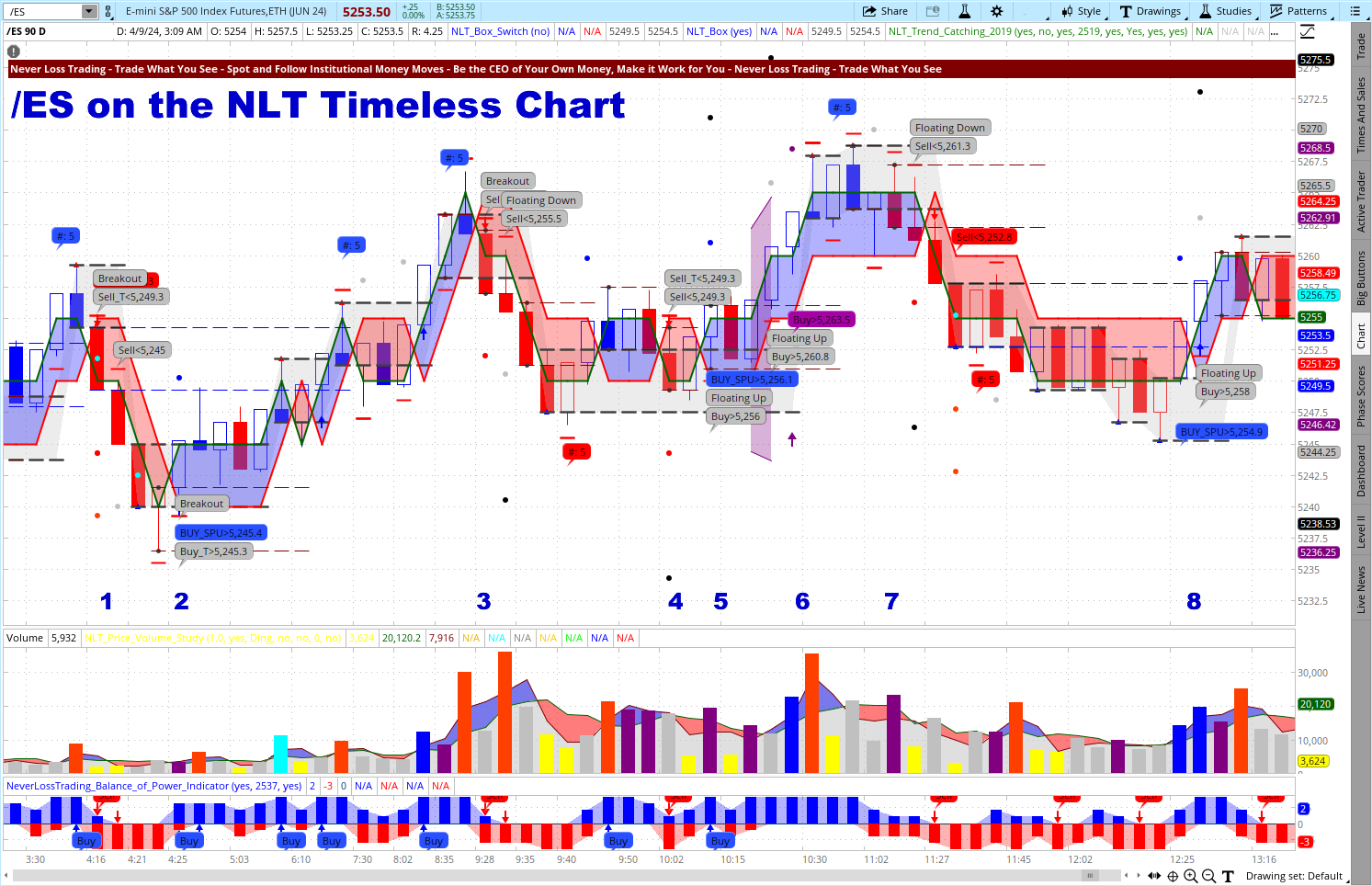
At NeverLossTrading (NLT), we approach these decisions differently. Rather than leaving critical decisions entirely to subjective judgment, we use a systematic framework to identify price-turning points, estimate expected price expansion, define entry thresholds, and establish target and stop levels.
The objective is not to predict every market movement. It is to identify opportunities where the relationship among probability, potential reward, and defined risk yields a meaningful statistical advantage.
1. The difference between a prediction and a statistical edge
Many trading approaches begin with a directional opinion. A trader believes that a stock, index, or futures contract will rise or fall and then searches for an entry point.
However, knowing the likely direction is only one part of the decision.
A complete trade requires answers to several questions:
- Direction: Is the market showing evidence of upward or downward pressure?
- Timing: Is the current price movement offering a suitable entry opportunity?
- Confirmation: What must price do next to validate the signal?
- Reward and risk: What are the expected target and the defined stop level?
- Execution: Does the opportunity fit the trader’s risk tolerance and trading horizon?
NLT brings these elements together in a structured process. The system identifies a potential turning point and establishes price levels that can guide the subsequent decision.
Instead of asking, “What do I think the market will do?”, the trader can ask, “What does the current setup indicate, what would confirm it, and what is the defined opportunity if confirmation occurs?”
That distinction matters. An opinion can remain unchanged even as market conditions deteriorate. A systematic decision, by contrast, can be reassessed against observable price behavior.
2. Why appropriate stops matter more than simply tight stops
Risk control is fundamental to long-term trading. But risk control should not be confused with placing the smallest possible stop on every trade.
Markets fluctuate. Prices can move temporarily against an entry before continuing in the anticipated direction. If a stop does not account for the volatility inherent in the setup, a trader may prematurely exit otherwise valid trades.
Consider a hypothetical example.
A trader enters a position at $100, expecting a move toward $103. A stop at $99.80 may look attractive because the initial risk is only $0.20 per share. But if ordinary price fluctuations regularly exceed that distance, the position may be closed before the anticipated move develops.
A wider stop could provide more room, but it also increases the amount at risk per share. The position size must therefore be adjusted accordingly.
The objective is not simply to widen stops. It is to establish a coherent relationship between the entry, the volatility the trade must withstand, the target, and the amount of capital committed.
NLT From Opportunity to Execution

Define the Trade Before Committing Capital
Before entering a trade, define the entry conditions, the profit target, and the point at which the trade thesis is no longer valid. The NLT framework uses system-defined entry, target, and stop levels to structure these decisions. The goal is to give a qualifying price move room to develop while keeping the potential risk explicit.
A systematic framework can help traders make decisions consistently, rather than improvising under pressure. It does not eliminate risk or guarantee an outcome; it provides a plan to manage uncertainty before capital is committed.
3. The Mathematics of a Trading Edge
A strategy’s performance depends on more than its win rate. The average size of its wins relative to its losses also matters. A basic estimate of expected value is:
Expected value = (Win probability × Average win) − (Loss probability × Average loss)
For example, consider a hypothetical strategy that wins 70% of the time, with an average gain of $300 and an average loss of $360:
(0.70 × $300) − (0.30 × $360) = $102
Under these assumptions, the strategy has an expected value of $102 per trade before commissions, slippage, and other costs. This is an average across many trades—not a prediction that any individual trade will earn $102.
A high win rate alone does not prove that a strategy has an edge. Win probability, average reward, average loss, and trading costs must be considered together. The NLT Timeless Day Trading system is designed to apply defined rules to chart indications, while helping traders distinguish higher-probability setups from less favorable ones. Actual results can vary, and should be assessed over a sufficient sample of trades with realistic costs included.
4. NLT Timeless Trading: Focus on Price Movement
The NLT Timeless Trading concept focuses on how price develops and whether a setup forms, rather than assuming that every fixed time interval offers the same opportunity. This approach rests on three principles:
- Wait for the setup. A moving market is not automatically a tradable market. Look for price action to develop into a recognizable opportunity that meets the system’s criteria.
- Seek confirmation. A potential turning point is not necessarily an instruction to enter immediately. A defined price threshold can help confirm that the anticipated move is developing before you act.
- Respect the target and stop. Once a trade is validated, predefined levels provide a framework for managing the position and limiting risk, rather than relying solely on emotion or improvisation.
The aim is to reduce arbitrary decisions and make trading actions more consistent with observed price behavior. Timeless trading does not eliminate uncertainty or make every market condition equally favorable; it offers a framework for evaluating price development and deciding when a trade may be appropriate.
5. A real trading week: October 5–9
The following examples, supplied from NLT’s trading records, illustrate how a systematic approach can include both profitable trades and losing trades.
October 5 — E-Mini S&P 500

NLT upside breakout trade with a recorded result of $312.50 from one /ES trade. The described setup was an upside breakout accompanied by high volume in the preceding period.
The educational point is that the opportunity was associated with an identifiable price event and supporting volume, rather than a directional opinion alone.
October 6 — Two /ES trades

The reported combined gain was $562.50 across two trades, but there’s more to the story: On the first trade of the day, we acted in the NLT Red Zone, where strong directional price movement can create breakout opportunities: I clicked too quickly and entered two contracts instead of one, taking on more risk than I was prepared to accept for that setup. Although the trade later would have reached its target, I closed it early to bring the risk back under control.
Consistent risk management is essential for building long-term trading income. I then waited for and took another textbook setup. Execution mistakes can happen to anyone; that’s why it’s important to have a plan—and a flatten button—to manage risk when something goes wrong.
October 7 — A difficult day

This was the challenging session of the week. Two trades lost money despite what the source describes as favorable entries. A subsequent winning trade recovered most of the losses, and the reported net result for the day was a loss of only $12.50.
This is perhaps the most useful example in the series.
A favorable entry does not guarantee a winning trade. A sound process must accommodate the possibility that a valid setup will fail. The objective is to limit the damage of unsuccessful trades without arbitrarily restricting the potential of successful ones.
The example also illustrates why individual trades should be considered within a broader risk-management framework and in the context of repeated execution.
October 8 — Continued execution

A textbook red-zone breakout trade with a favorable entry to cope with the potential upside of a border conflict resulted in a gain of $350.
October 9 — Continued execution

Again, a red-zone trade indicated an upside move, and we dimensioned the entry to handle the upper channel border for a $375 gain.
Taken together, the five daily results reported in the source amount to a net gain of $1,587.50 for the week.
These figures are a specific historical example, not an independently audited performance record. They do not establish that future trades will produce comparable results, and they should not be interpreted as a typical or guaranteed weekly outcome.
Their educational value lies in the process they illustrate: profitable trades can coexist with losing trades, and the result depends on how opportunities, losses, and rewards are managed across a series of decisions. You can find further educational examples on our blog, where we share the trading results of the prior weeks with time stamps for entry and exit on each chart.
6. Why disciplined execution matters
Even a well-designed trading system cannot create an advantage if its rules are followed inconsistently.
A trader might receive a valid signal but hesitate because the previous trade lost money. Another might enter before confirmation for fear of missing the move. A third might increase position size after a winning streak or abandon a sound setup after several losses.
These reactions introduce decisions that may have little to do with the actual quality of the opportunity.
The NLT philosophy is built around a different sequence:
- Identify the market opportunity.
- Wait for the defined NLT turning point and confirmation.
- Evaluate the potential reward against the defined risk.
- Determine whether the trade fits the intended time horizon and risk tolerance.
- Commit an appropriately sized position and follow the system’s management rules.
This sequence makes an important distinction: the quality of a trade should determine whether it is taken—not the trader’s desire to be active.
Some sessions offer several attractive opportunities. Others offer very few. Remaining inactive when the conditions are not suitable is a legitimate trading decision.
The goal is not to trade more. It is to make better-defined decisions when the market presents an opportunity that meets the required conditions.
7. What traders should evaluate before trusting any system
A statistical edge must be demonstrated through evidence, not just described in theory.
Before committing substantial capital to a strategy, traders should examine:
- Win rate: What proportion of trades reach their intended profitable outcome?
- Average win and average loss: Does the reward-to-risk relationship support positive expected value?
- Trading costs: How do commissions, spreads, and slippage affect the results?
- Drawdowns: How large and how prolonged have losing periods been?
- Market conditions: Does the approach remain useful across different volatility and trend environments?
- Sample size: Are the results based on enough trades to support meaningful conclusions?
- Execution discipline: Do real trades reproduce the assumptions used in testing?
NLT’s stated objective is to identify opportunities with favorable probability and a defined relationship between potential reward and risk. Any numerical accuracy claim, including an approximate 70% historical probability, should be assessed against documented results, the precise conditions tested, the sample size, and the effects of trading costs.
Historical accuracy is not a guarantee of future profitability. A disciplined trader must remain prepared for losing trades and unfavorable market conditions.
Conclusion: Trade what you see, not what you think
The appeal of day trading is the opportunity to act on price movements as they unfold. The challenge is distinguishing a genuine opportunity from the market’s continuous noise.
The NLT Timeless Trading Concept seeks to address this challenge through a structured approach to price-turning points, confirmation, expected price expansion, and predefined trade management.
Rather than relying exclusively on predictions, the trader follows a defined sequence: recognize the setup, validate the opportunity, evaluate the risk and reward, and execute according to the system.
This does not eliminate losses, nor does it make trading easy. It provides a framework for making decisions more consistently and evaluating whether those decisions offer a measurable statistical advantage.
At NeverLossTrading, the guiding principle is straightforward:
Trade what you see, not what you think.
A statistical edge does not guarantee that every trade will succeed. The objective is to build a repeatable process in which probability, risk, and execution work together—and to allow the results from a sufficiently large sample of trades to determine whether that process truly delivers an advantage.
Ready to Trade with an Edge?
Learn one-on-one about the NLT Timeless concept.
 Contact us: contact@NeverLossTrading.com — Subject: NLT Timeless Day Trading
Sign up for our free trading tips.
Good trading,
Thomas F. Barmann


 Schedule a private consultation
 Subject: Timeless Demo