Spot and Trade Institutional Money Moves

Algorithmic Trading with Human Interaction for:

Day Traders, Swing Traders, Long-Term Investors

Saturday, June 25, 2022

Buy at the High and Sell at the Low

Summary: Learn about crucial success principles as a retail trader by letting the chart tell when to buy or sell!

Our headline sentence is not a success principle but often a retail trader reality. People who come to trading with the understanding that they know the markets tend to enter into a price move late and get burned: making the trend your friend is easier said than done.

If making money in the financial markets was easy, nobody would ever go to work, but it is learnable, and we want to share the crucial principles to follow with you.

Doing it right is to find crucial price turning points and act with risk-limiting strategies on upside and downside price movements of the asset class you chose to interact with: stocks, options, futures, and FOREX.

Trading Perspective by NeverLossTrading

Your trading and investing decisions should be based on what the market tells you, supported by software that paints the most likely happening on the chart, giving specific conditions for entering and exiting a trade. This way, you do not even have to be in front of your computer to participate in the markets.

However, one trading style does not fit all. This is why we adapt our systems to clients’ specific wants and needs, accepting different personalities, available times, risk acceptance, and styles.

In his book, Jack D. Schwager, Market Wizards, reports how he interviewed the world’s best traders, assuming they all traded the same way. Still, he realized that no two of them traded alike. However, they all traded in line with their personality, which is why we teach one-on-one at your best available time, tailoring our systems and strategies to your needs. In more than ten years in the trading education business, we did not meet two traders who followed and executed trades continuously the same way.

Here are some of the crucial variables to translate from what made the Market Wizards successful: 

  • Follow a system that helps you find price turning points and continuation patterns.
  • Capital preservation is the most crucial aspect, and as such, do not overleverage on risk – work with risk-liming strategies and partition your correlated risk for each trade.
  • Pride or being convinced you know what is going to happen has caused a majority of the traders to lose heftily. Being confident causes traders to stick with losing positions or even adding to them; instead of letting the market and system tell when to buy or sell.
  • Understand and accept that you work in an environment with no 100% certainty that the trade will work your way. Do not confuse winning and losing trades with good and bad trades. A good trade can lose money, and a bad trade can make money; what determines good and bad is if you apply and stick with clear-cut principles.

When we work together, you will learn what kind of trading you are good at and what suits your available time: day trading, swing trading, and longer-term investing.

Trading success derives from the basis of your decision-making. No system and situation is 100% certain. As a trader, you deal with the probability of appraising each case and the likelihood that a price move will be initiated and come to a pre-defined target or stop.

With our systems, we went a step ahead and formulated entry conditions by the system spelling out price thresholds: Buy > or Sell < and only if those conditions are met will an order be sent to an exchange.

Let me give you some examples:

Aside from trading of time-based happenings, we let our system specify price intervals to trade for. Therefore, there are multiple advantages for you as a trader to consider such a concept:

  • Risk and reward are always in an acceptable balance with the system probability. However, large candles easily throw risk and reward out of balance when using time-based charts.
  • Your acting in the market is less predictable than using time-based charts, where it is relatively straightforward where stops sit.
  • You have a clear income and risk perspective, trade by trade.
  • You trade at crucial price turning points that offer enough time to set your buy-stop and sell-stop orders. Orders only go to the exchange when your system formulated price threshold is surpassed in the next candle: You see the crucial price threshold on the NLT Dashboard in the development of the candle.
  • Our system will give you multiple opportunities to act on momentum changes and on-trend developments.

We pick a day trading example for the E-Mini S&P 500 futures contract: the morning session of July 17, 2022, where our NLT Trend Catching system is combined with NLT Timeless and printed six trading opportunities: five winners, one loss, accepting trades pure mechanically.

ES on the NLT Timeless Chart, June 17, 2022
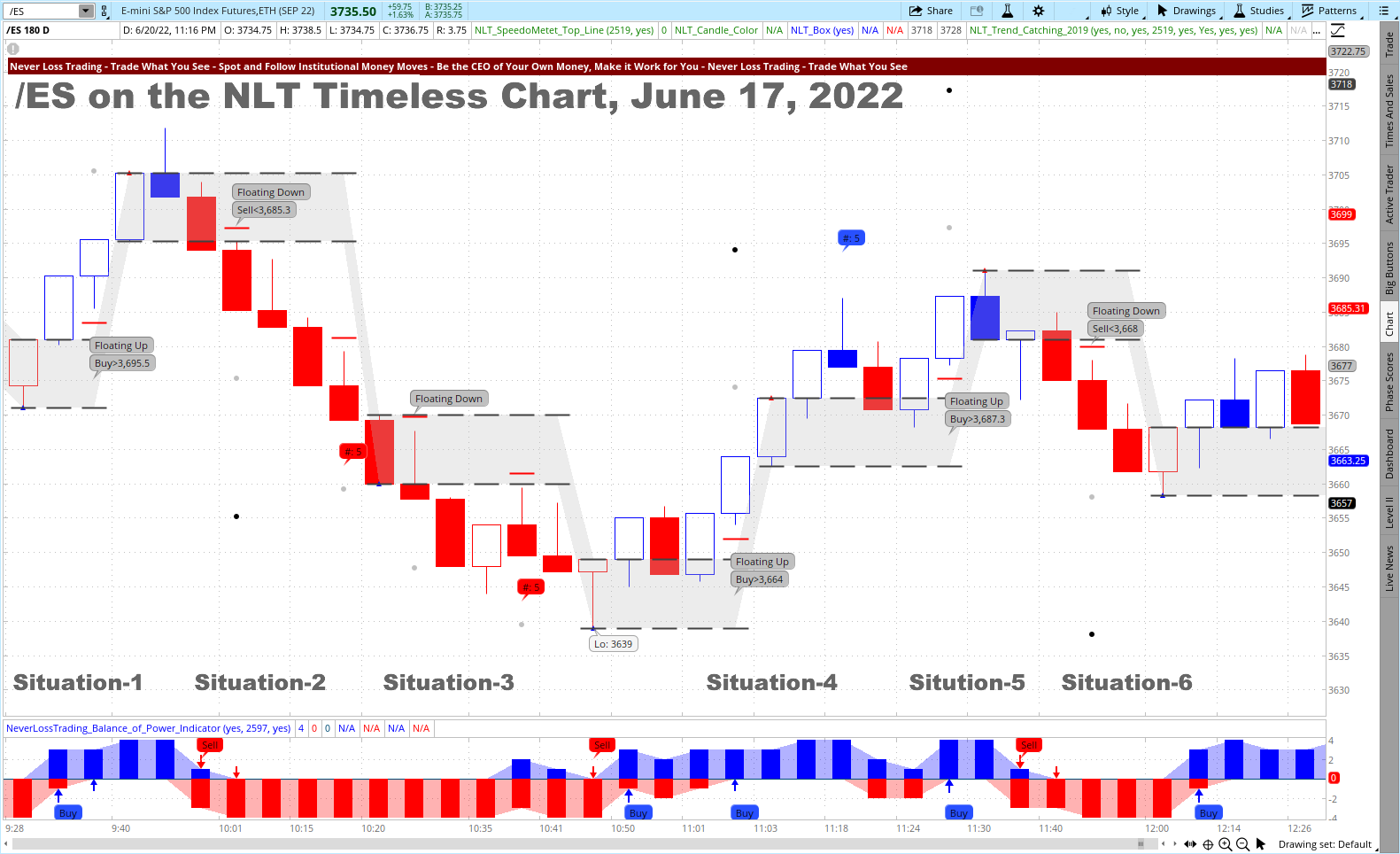
E-Mini S&P 500 Futures Contract on the NLT Timeless Chart

Situation-1: Buy > $3695.50 was printed on the candle that opened at 9:33 a.m. and confirmed by 9:40 a.m. A gray dot sets the target on the chart, and the stop is at the red crossbar. In the price development after entering the trade, the target was reached in the 9:51 candle.

Situation-2: Sell < $3685.30 at 10:01 was confirmed in the 10:09 candle and reached its target in the 10:15 candle.

Situation-3: Floating signal at the 10:29 candle that reached its target in the 10:35 candle.

Situation-4: Buy > $3664 in the 11:01 candle that reached its target in the 11:07 candle.

Situation-5: Buy > $3687.30 (11:27), this trade got stopped.

Situation-6: Sell < $3668 on 11:42, came to target at the noon candle.

The chart is in original conditions without magnifying situations; each trade was good for a price change of $450. Had you traded all situations with one contract, an income of $1,650 would have been created between 9:30 a.m. and noon.

In the next step, we take the same system chart and run the E-Mini S&P 500 Futures Contract on a five-minute chart:

ES on the 5 Min. NLT Trend Catching Chart

E-Mini S&P 500 Futures Contract on the NLT Trend Catching Chart

Here, the system spelled out two trade situations:

Situation-1: Sell < $3684.50 at 10:05 was not confirmed in the price movement of the next candle, and no trade was conducted.

Situation-2: Buy > $3669 at 11 a.m. was confirmed in the next candle, came to target in the 11:15 candle, and produced an income of $600 per contract.

Two different ways of trading; both provided successful opportunities and stayed in our proposed probability of forecasting the price move accurately at or above 65%. In this case, the timeless concept provided more trading opportunities, and such was the sufficient solution.

Technology is the crucial trigger for the market to make its turns; hence, we pick the QQQ (ETF of the NASDAQ 100 Index) between May 20 and June 17, 2022. Institutional investment decisions are often made based on daily charts. In the daily QQQ chart, we combine NLT Top-Line and Trend Catching indicators.

Why combine NLT systems?

An easy answer:

To achieve a higher participation rate or trade efficiency (trades per observed time).

QQQ on the Daily NLT Top-Line and Trend Catching Chart
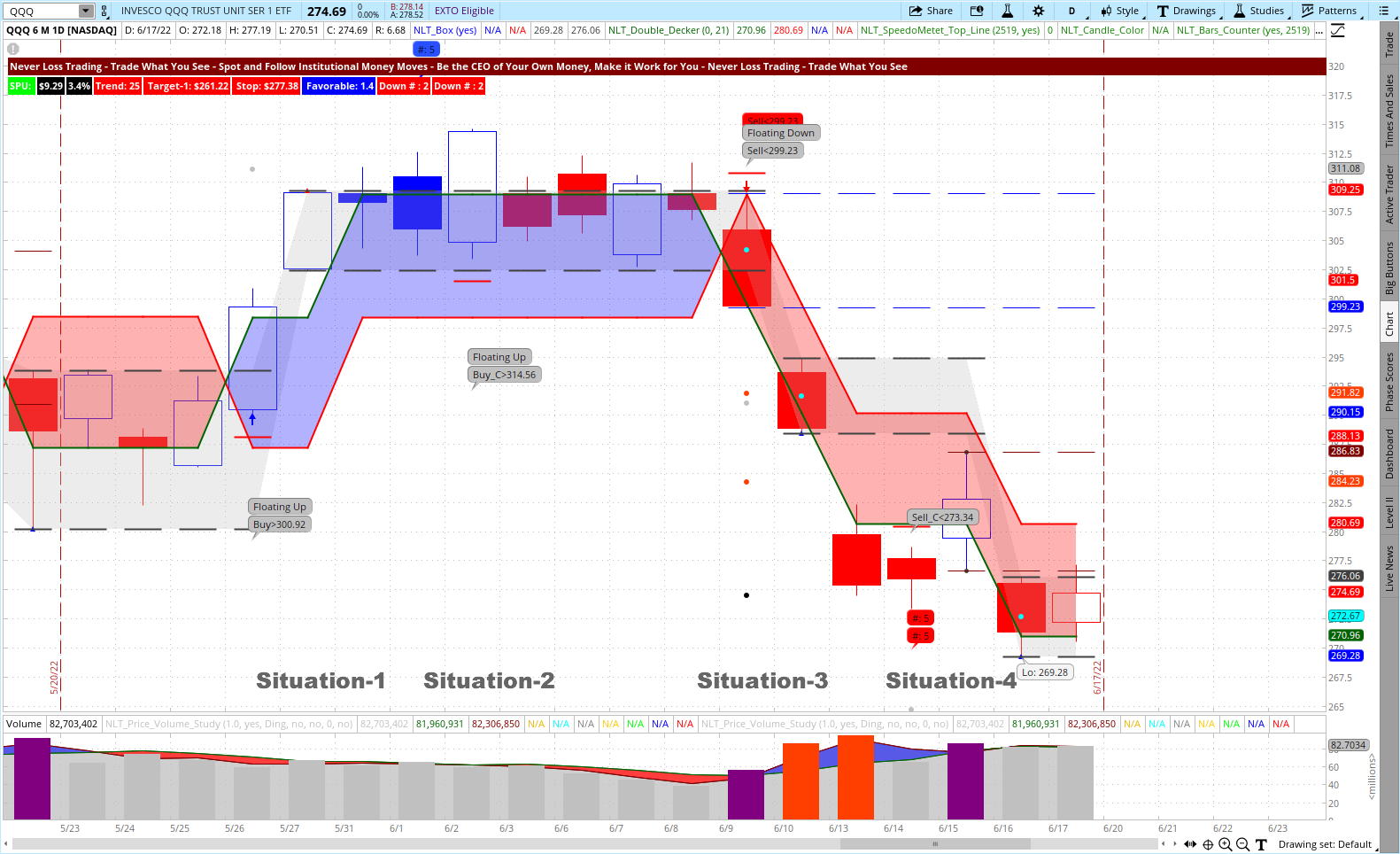
QQQ on a Daily NeverLossTrading Top-Line Chart

Chart discussion:

Situation-1: Buy > $300.92 on May 26, 2022, was confirmed in the price movement of the next candle and cam to target on June 1, 22.

Situation-2: Buy > $314.56 was not confirmed and did not lead to a trade.

Situation-3: NLT Top-Line and NLT Trend Catching sell signal at the candle of June 9, 2022, led to a solid 3-SPU drop (black dot on the chart), where the price move is haltering.

Situation-4: Sell < $273.34 was not confirmed, and no trade resulted.

The examples we picked hopefully give you an insight into rule-based trading, where the system formulates specific entry, exit, and stop conditions.

For our subscribers, we create the NLT Alerts where you can find potential trading opportunities for Stocks, Options, Futures, and FOREX. Subscribers receive those in the early morning hours of the approaching day to be ready for trades that day.

Many of our traders combine systems for a higher participation rate: more trades per time unit for higher productivity in their trading endeavors.

Our most popular systems are:

Type TraderProgramFocus
BeginnersTradeColors.comConfirmed Price Moves
AdvancedNLT Top-LineEarly Price Turning Points
Frequent TraderNLT Trend Catching and SPU Move NLT TimelessMomentum and Trend

contact@NeverLossTrading.com, Demo, and find out which system suits you best.

Here are some success principles:

  • Trading is about finding opportunities for solid price movements of assets.
  • You will not be 100% right in your judgment, and your way of making money is that you are more often right than wrong in your appraisal.
  • You want to follow a high probability system and participate in multiple opportunities with pre-specified entry and exit conditions (including the stops)

We offer you knowledge, systems, concepts, strategies, coaching, and training programs to help you develop into the trader or investor you want to be.

TradeColors.com is our entry-level system and offers day traders, swing traders, or longer-term investors a basis for trading at crucial price turning points.

TradeColors.com Daily chart May 20 to June 17, 2022

SPY on a Daily TradeColors.com Chart

The chart shows that the system, which trades at two new same-color candles and the high of the second candle ticked out in the price development of the next candle: this was the fact and led to a trade on 5-27-22, which came to target June 2. Next came a short signal on 6-9-22, which came to target on 6-13-22.

Get ready to change your decision-making or system and investment strategies. Ongoing education and mentoring are crucial to longevity in this business. Veteran traders have been through more ups and downs than you can imagine. So, experienced pros have probably experienced whatever you’re going through.

If you are ready to learn, meet us in a one-on-one session where we find out which learning program suits you best:

contact@NeverLossTrading.com Subj: Demo.

We share our experiences and help you build up your trading business.

Trading is not a typical career, and you best learn from those who are long-term in this business to cope with the rollercoaster of the financial markets. We are here to help and provide feedback on what you might be doing right or wrong.

Make a change to your trading results, and we will find out which of our systems suits you best.

Whether the bulls or bears dominate, commit to high probability setups and strategies applicable to every market condition. Limit your risk and follow a business plan for trading success, including an action plan (in which situations to trade and in which not) and a financial plan (how many trades, maximum risk, and time in transactions).

Trading success has a structure!

Assets & TimeStocksOptionsFuturesFOREX
Day Trading-Timeless
-Time-Based
X-Timeless
-Time-Based
-Timeless
-Time-Based
Swing Trading-Timeless
-Time-Based
NLT Delta Force Concept-Timeless
-Time-Based
-Timeless
-Time-Based
Investing-Weekly Decisions
-Timeless
-Weekly Decisions
-Timeless
-Weekly Decisions
-Timeless
-Weekly Decisions
-Timeless
Ways to Market by NeverLossTrading

Make a change to your way of trading; we are here to contribute with our education to help you trade in any market condition,

Thomas Barmann (inventor and founder of NeverLossTrading)

www.NeverLossTrading.com

Disclaimer, Terms and Conditions, Privacy | Customer Support

Saturday, June 18, 2022

Trade What You See

We are writing the year 2022, and computer technology with AI components is present for retail traders to support your trading decisions. However, still many trade what they think and find multiple reasons to buy and hold specific assets in their portfolio. So we share a different methodology with you.

Trade What You See

Stock markets worldwide have entered a bear market, where buying and holding is a detrimental strategy. If you follow it, you have already lost 20% over your 2021 portfolio value, and more losses are on the horizon for you.

What to do as a retail trader in times of directional ambiguity?

The answer:

  • Position yourself shorter-term with strategies that gain if the markets go further down or up again
  • Operate with risk-limiting strategies by trading stock options or stocks in combination with options
  • Establish hedges with futures to protect your holdings in case of another landslide of falling stock prices
  • Learn to day trade or swing trade  

In essence, if you come to trading with preconceived ideas about what should and should not happen, you contemplate the high rate of retail traders losing money. This is especially true if you are coming to trading from a successful career, thinking you understand the market trends, transactions, and the economy.

Your choices in the market should be based on what the market is telling you, supported by a software that paints the most likely happening on the chart for you, giving specific conditions for entering and exiting a trade. This way, you do not even have to be in front of your computer when entering or exiting a transaction.

However, one trading style does not fit all. This is why we adapt our systems to clients’ specific wants and needs, accepting different personalities, available times, risk acceptance, and styles.

In his book, Jack D. Schwager, Market Wizards, reports how he interviewed the world’s best traders, assuming they all traded the same way. Still, he realized that no two of them traded alike. However, they all traded in line with their personality, which is why we teach one-on-one at your best available time, tailoring our systems and strategies to your needs. In more than ten years in the trading education business, we did not meet two traders who followed and executed trades continuously the same way.

When we work together, you will learn what kind of trading you like and what kind of trading you are good at: day trading, swing trading, and longer-term investing.

Trading success derives from the basis of your decision-making. No system and situation is 100% certain. As a trader, you deal with the probability of appraising each case and the likelihood that a price move will be initiated and come to a pre-defined target or stop.

With our systems, we went a step ahead and formulate entry conditions by the system spelling out price thresholds: Buy > or Sell < and only if those conditions are met will an order be sent to an exchange.

Let me give you some examples:

Swing Trading and Longer-Term Investing Examples

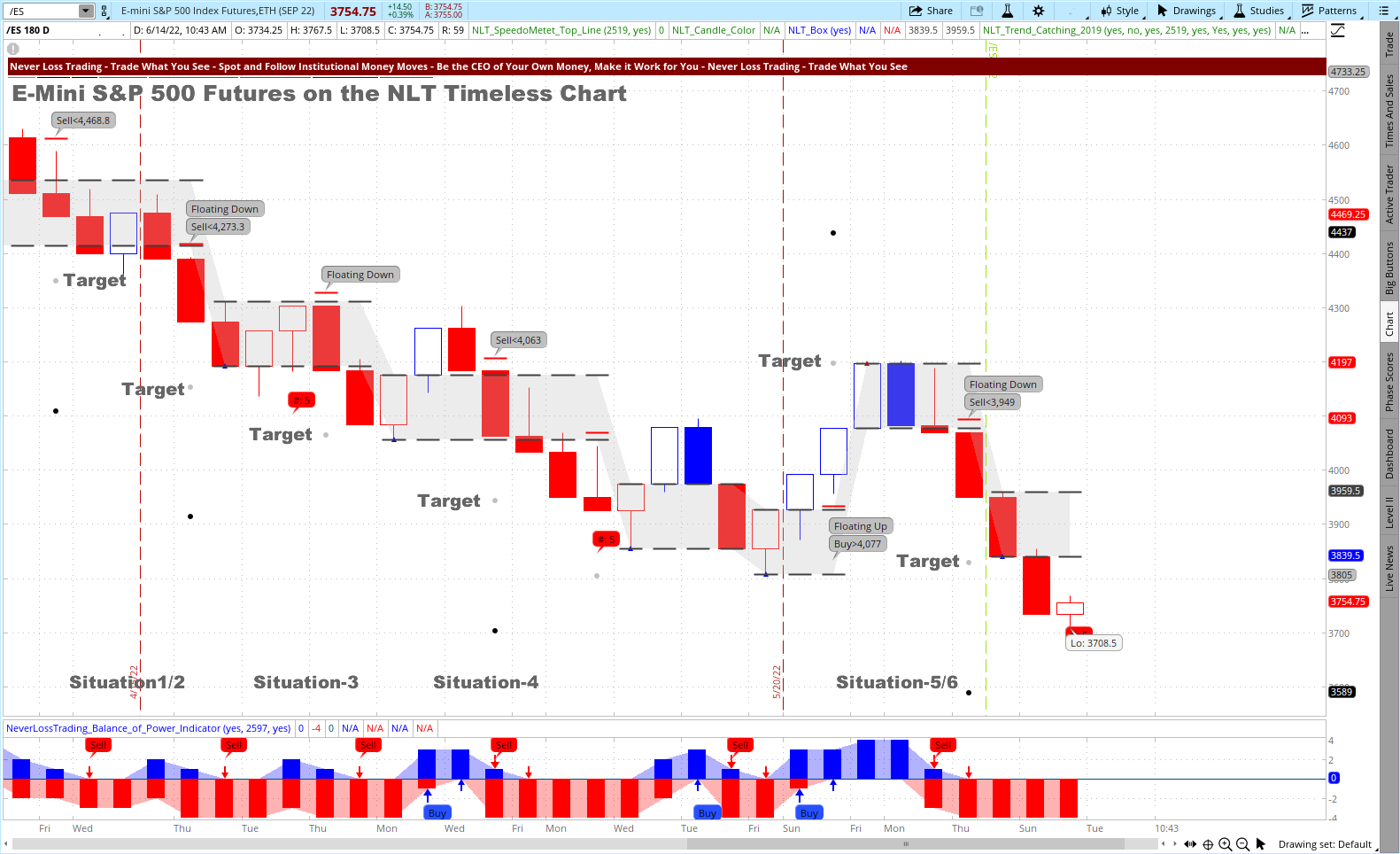
In the first example, we pick the E-Mini S&P 500 Futures contract and formulate trade situations with the help of the NLT Timeless Concept. Instead of painting time-based candles, each candle is painted by a pre-specified price change. The following chart highlights six situations between March 29, 2022, and June 15, 2022; we will discuss them individually. Operating in times of uncertainty, we take shorter-term investments only and expect to hold positions between one and ten days.

E-Mini S&P 500 on the NLT Timeless Trend Catching Chart

Situation-1: On April 1, 2022, the NLT TrendCatching System gave a potential sell signal: Sell < $4468.80. If the price movement of the next candle dropped below this price threshold, we entered into a trade. The gray dot on the chart was the target, and the red crossbar above the candle functioned as the stop. On 4/11/2022, the trade came to the target and produced $6,000 of income. To make this trade, you had to hold about $12,500 in your brokerage account. If trading the mini contract is outside your risk tolerance, trading the micro-future contract would have only required 10% of the holdings and produced $600 of income per contract and trade.

Situation-2: On 4/21/2022, another sell signal came up: Sell < $4273.30, marked as floating, which determines that the price move broke out of what we call a containment area and has a high likelihood of fulfilling its expected move, and on 4/26 it came to target.

Situation-3: On 4/28, Floating down came to target on 5/2/2022.

Situation-4: On 5/5, another sell signal came to target on 5/11.

Situation-5: 5/25, Buy > $4077, Floating Up, came to target on 5/27.

Situation-6: 6/9, Sell < $3949 was confirmed in the price movement of the next candle and came to target on 6/12.

In the highlighted sequence, we had only winning trades, but this is not our promise; based on past performance, our systems rank in forecasting the price move with a likelihood > 65%.

Had you traded along this signal sequence, you would have produced an income of about $36,000 in six weeks, exchanging one contract, and your account minimum was $12,500.

Our systems also work with stocks; however, for shorting stocks, multiple conditions must be fulfilled, one being that the share needs to be ready to be borrowed from your broker. Let us take Tesla as an example; the daily price movement of TSLA allows for solid participation in directional price moves; however, most of the time, TSLA is rated HTB (hard to borrow) and thus, not available for shorting.

To demonstrate the short potential of TSLA, we put the stock on the weekly NLT Top-Line Chart, including the SPU Move Indicator, and you will see multiple trade situations that came to the dot on the chart. From left to right, numerous trading opportunities were highlighted and had we acted on them; four were confirmed and winning, each for about 18% return on cash.

TSLA Weekly NLT Top-Line Chart

TSLA on the Weekly NLT Top-Line Chart

The duration of the trades was between one and three weeks of holding the position to the pre-set price target (dot on the chart). To follow the price moves of stocks that are hard to borrow, we share in our mentorships options trading concepts that help you to specify:

  • The strike price to choose for the highest return
  • The time to expiration to pick
  • The maximum price to pay for a single option or changing the trading strategy to debit or credit spreads

When you subscribe to NLT Top-Line, we explain and share all details in 20 hours of individual training.

For our subscribers, we create the NLT Alerts where you can find potential trading opportunities for Stocks, Options, Futures, and FOREX. Subscribers receive those in the early morning hours of the approaching day to be ready for trades that day.

Many of our traders combine systems for a higher participation rate: more trades per time unit and such have higher productivity of their trading endeavors.

Our most popular systems are:


contact@NeverLossTrading.com, Demo, to find out which system suits you best.

Here are some success principles:

  • Trading is about finding opportunities for solid price movements of assets.
  • You will not be 100% right in your judgment, and your way of making money is that you are more often right than wrong in your appraisal.
  • You want to follow a high probability system and participate in multiple opportunities with pre-specified entry and exit conditions (including the stops)

We offer you knowledge, systems, concepts, strategies, coaching and training programs to help you develop into the trader or investor you want to be.

Day trading is another excellent opportunity to participate in risk-limiting trades at crucial price turning points. The chart we chose shows the day of June 14 and recorded the time of 9:45 a.m. to 4 p.m. EST. Ten trade situations were recorded; eight came to target and produced a win of about $500 per contract; two lost about $600 each. Hence, had you participated in all trade situations trading one contract, you produced $2,800 of income in one day. The chart comprises NLT Trend Catching and Timeless Indicators, and each candle represents a pre-defined price move. Again, the gray dot on the graph represents the target and the red crossbar the stop. Price thresholds are announced in the pre-development of the candle and allow entering into a bracket trade through buy-stop or sell-stop orders.

NLT Timeless /ES Trading on June 14, 2022

E-Mini S&P 500 Futures Contract on the NLT Timeless Trend Catching Chart

Please magnify the situations and check the validity of what we share with you.

Get ready to change your decision-making or system and investment strategies. Ongoing education and mentoring are crucial to longevity in this business. Veteran traders have been through more ups and downs than you can imagine. So, experienced pros have probably experienced whatever you’re going through.

If you are ready to learn, meet us in a one-on-one session where we find out which learning program suits you best:

contact@NeverLossTrading.com Subj: Demo.

We share our experiences and help you build up your trading business.

Trading is not a typical career, and you best learn from those who are long-term in this business to cope with the rollercoaster of the financial markets. We are here to help and provide feedback on what you might be doing right or wrong.

Make a change to your trading results, and we will find out which of our systems suits you best.

Whether the bulls or bears dominate, commit to high probability setups and strategies applicable to every market condition. Limit your risk and follow a business plan for trading success, including an action plan (in which situations to trade and in which not) and a financial plan (how many trades, maximum risk and time in transactions).

Trading success has a structure!


Make a change to your way of trading; we are here to contribute with our education to help you trade in any market condition,

Thomas Barmann (inventor and founder of NeverLossTrading)

www.NeverLossTrading.com

Disclaimer, Terms and Conditions, Privacy | Customer Support

Thursday, June 2, 2022

High Probability Day Trading

 Summary: Experience how to follow a mapped-out guideline for high probability day trading, documented in a video.

Day trading can provide an excellent opportunity for producing constant income from the financial markets; however, by our statistics, 76% of short-term traders lose money, 16% have only random income, and 8% produce constant income from the financial markets.

High Probability Day Trading

What is the basis of day trading success?

Successful day traders are patient until the right moment is painted on their chart to risk their money. Conversely, traders who struggle participate in too many trade situations that are not at a high probability.

Let us take a little excurse to explain the facts: If you invest in multifamily real estate, you consider:

  • Location and value development
  • Occupancy rate
  • Depreciation
  • Maintenance costs
  • Interest

To calculate your free cash flow and expected return on investment. As a real estate investor, you will only risk your money when your minimum requirements on return on investment and free cash flow are fulfilled: Single-minded and random choices are not success principles. The advantage of a real estate investor compared to a day trader is that you have more time to appraise the case; however, the real estate investor has fewer opportunities to compete for producing a return. 

As a trader, you best act in a similar fashion by following:

  • High probability situations, mapped by your system
  • Acting mechanical with pre-defined entry and exit points
  • Limiting your risk per trade
  • Accepting losing as part of winning, with no revenge trades
  • Following a financial plan to produce a desired weekly income and you stop trading or trade smaller when your income goal reached

In essence, only day traders with a structured approach will have a chance to succeed long-term. On the other hand, random choices and overtrading are the path of destruction and the reason that 76% of the day traders lose money.

Let us explain in a video how to act at high probability price turning points, participating in a maximum of four trading opportunities per day.

The Day Trading Challenge

Our NeverLossTrading concepts adapt to traders’ affinity, wants, and needs. We focus on acting at crucial price turning points and take price move indications from several sources. By combining NLT Systems, you can achieve a higher participation rate: more trades to participate per day, week, or month, where each system works as a standalone.

No trader is the same as another. We offer excellent customer service and adopt our systems to individual wants and needs, teaching and coaching at your best available days and times. We put together an overview of learning elements to take away from our training and coaching sessions.

Learning elements:

  • Acting with a system probability > 65%
  • Mechanical rules for entry, exit, stop
  • Trade at perfect moments only
  • Consider overall factors, patterns
  • Risk and reward in an acceptable balance
  • Risk-averse trading
  • Holding positions to target
  • Do not add to losers
  • Stick with a trading strategy. Follow a business plan – action plan and financial plan
  • Trade for meaningful price moves
  • Systematic trading with journaling and feedback
  • Having a mentor to learn from

Learning Elements to Trading Success

We also help you to journal your trades. Such a journal provides excellent feedback on how you are developing, and you find a perfect example in this article on our Blog: How to Control Your Trading Results

Get ready to change your decision-making or system and investment strategies.

To succeed in trading, you must work with an experienced coach and learn as much about trading. Our #1 competitive advantage is the support and customer service we offer. We work one-on-one with you to specify what we teach to your specific wants and needs; hence, if your knowledge base is not expanding rapidly, you are doing something wrong.

Ongoing education and mentoring are crucial to longevity in this business.

Veteran traders have been through more ups and downs than you can imagine. So whatever you’re going through, experienced pros have probably experienced it already.

If you are ready to learn, meet us in a one-on-one session where we find out which learning program suits you best:

contact@NeverLossTrading.com Subj: Demo.

We are ready to share our experiences and help you build up your trading business. Trading is not a typical career, and you best learn from those who are long-term in this business to cope with the rollercoaster of the financial markets. We are here to help and provide feedback on what you might be doing right or wrong.

Make a change to your trading results, and we will find out which of our systems suits you best.

We are happy to hear back from you,

Thomas Barmann (inventor and founder of NeverLossTrading)

www.NeverLossTrading.com

Disclaimer, Terms and Conditions, Privacy | Customer Support

Friday, May 27, 2022

Stock Trading Mid-Year 2022

Summary: Experience solid stock trading strategies and examples for mid-year 2022 forward. We share in this publication for traders who invest more than $40,000 in the stock market.

We are in a volatile market, and shorter-term swing trading provides higher profitability than long-term holding. If you want to hold a portfolio of stocks, you need to know how to put an automatic hedge in your portfolio and act on crucial price turning points; if you do not, you accept an extraordinary risk.

Stock Trading Mid-Year 2022 by NeverLossTrading

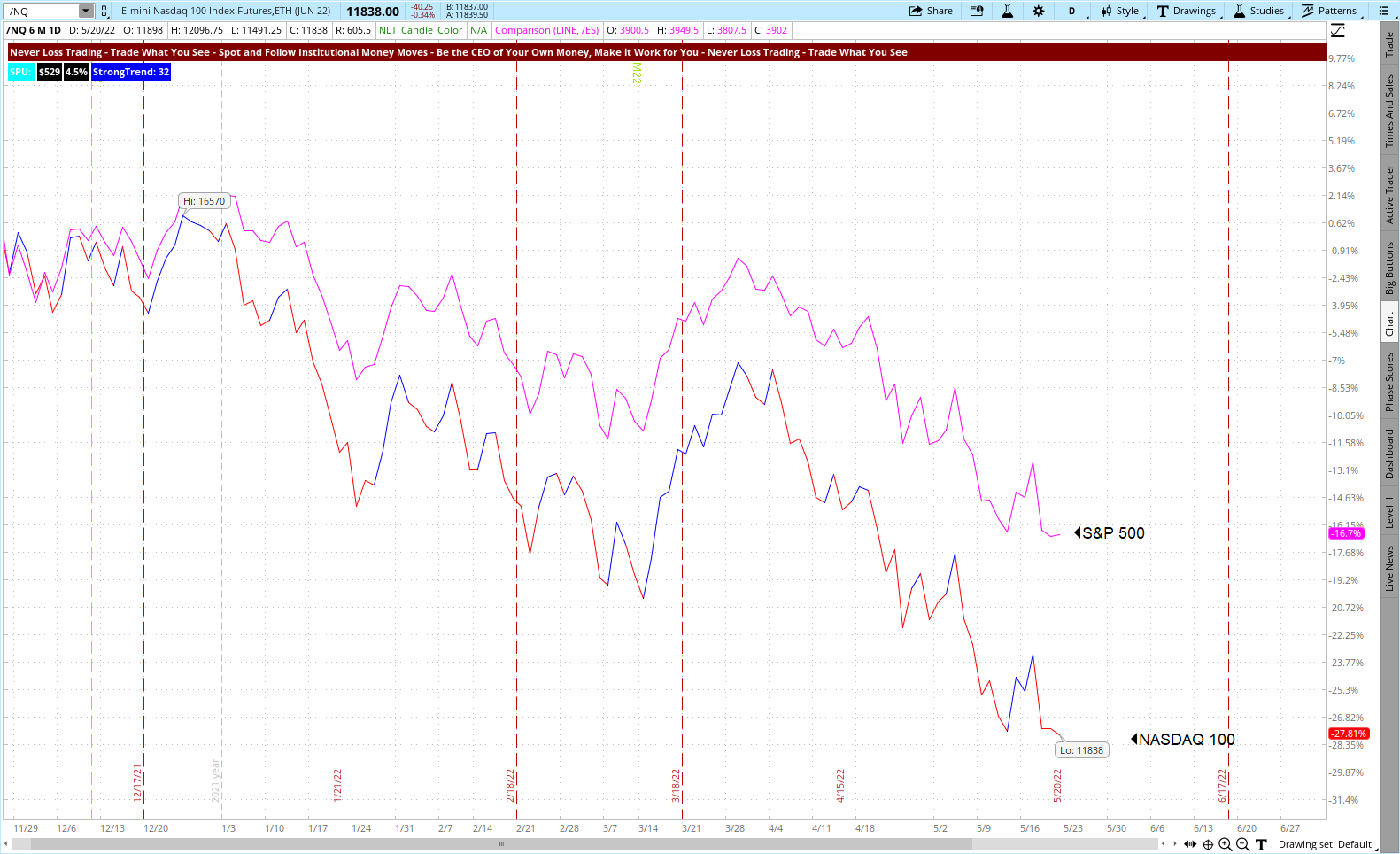
The average portfolio holding in 2022 is down by about 20%:

  • If you hold a NASDAQ 100-oriented portfolio, its value dropped by about 28% over the last six months.
  • An S&P 500-related portfolio dropped by about 17%.

Those are solid numbers, and by continuing to buy and hold, your portfolio value might soon be cut in half, requiring you to produce a 100% return to make up for the shortfall.

We best put this in perspective by charting the development of the S&P 500 and the NASDAQ 100 on a six months comparison:

S&P 500 and NASDAQ, Six Months Development May 2022

S&P 500 and NASDAQ 100 Development

What if you invested in growing sectors like Energy, Metals & Mining instead of Technology?

Technology, Metals & Mining, Energy, Six Months May 2022

Energy and Metal Stocks Development

In this case, you would be up in 2022 over 2021, while Metals & Mining gave a good portion of their development back. So to determine investment and cutoff points, you need a system.

Let us pick the example of XME, an ETF for Metals & Mining:

XME on the Weekly NLT Top-Line Chart

XME Weekly NeverLossTrading Top-Line Chart

We highlighted three situations on the chart:

Situation-1: NLT Purple Zone, which indicates ambiguity in the price development and you do not want to be invested in this phase, and disregard by and sell signals.

Situation-2: NLT Buy Signals at the end of the purple zone signify that the underlying asset is ready for a strong upside price move, which you can follow and trace by the blue framed momentum price development on the chart (blue for upside momentum, red for down).

Situation-3: Sell signal on the top, confirmed and should have led to an exit at $58.55.

If you managed your portfolio this way, you would have gained about 14% between February and April and closed your position not to give most of your gains back, which would have happened if you continued holding.

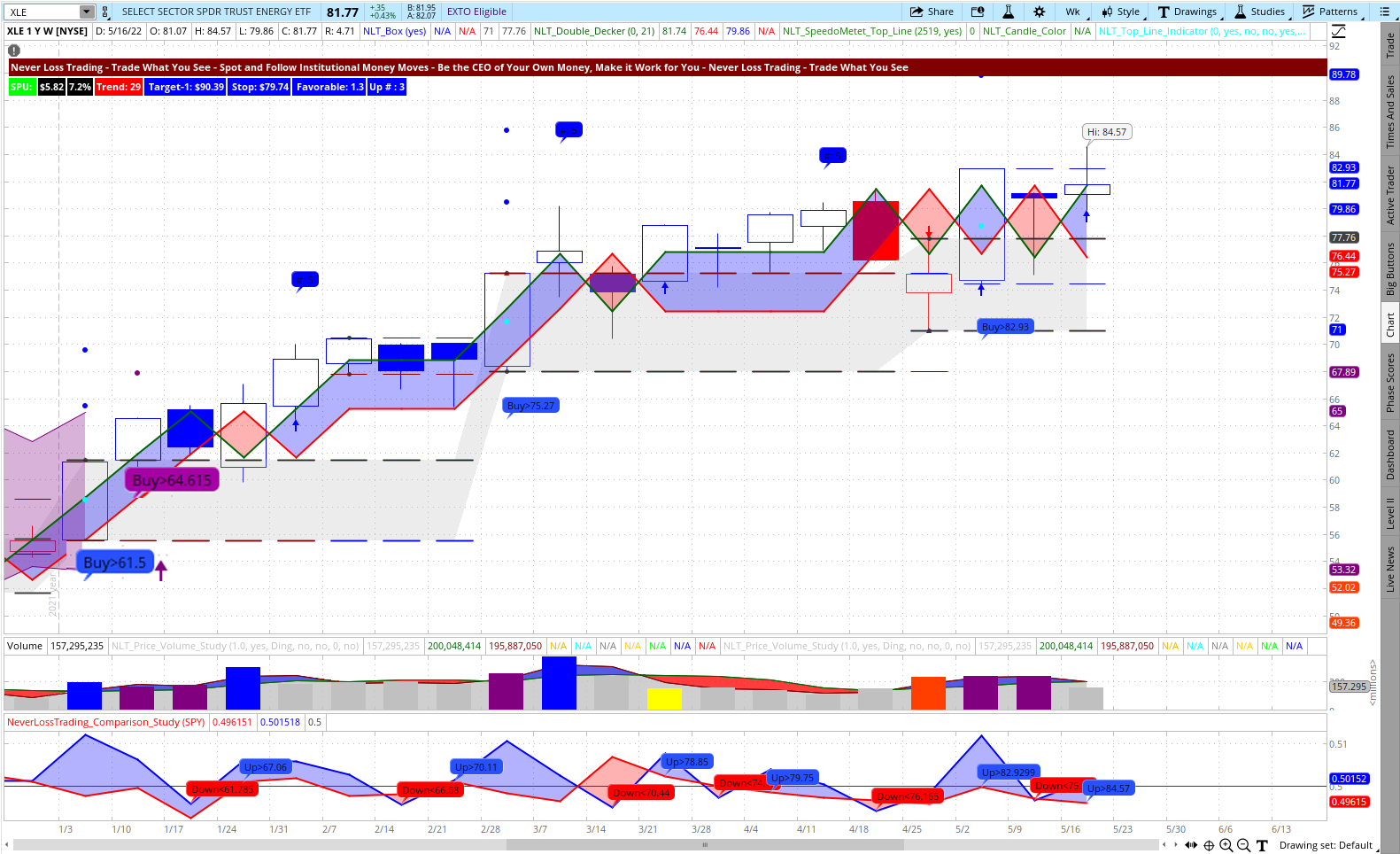
Next, we analyze the Energy sector by the XLE ETF:

XLE on the Weekly NLT Top-Line Chart

XLE Weekly NeverLossTrading Top-Line Chart

Beginning of the year 2022, the price development of XLE came out of the purple zone and had no sell signal on its way up. Therefore, we mark a critical price level: $77.76, where we would exit XLE long positions to find other investment opportunities.

Let us now check what the NLT Top-Line system said about the S&P 500 development in 2022 and explain it by highlighting three decisive price turning points the system mapped out, and we ask the following questions upfront:

  • Are you operating and acting by system-defined crucial price turning points?
  • Do you know short-selling strategies that help you to participate when markets tank in any of your accounts?
  • Can you apply portfolio hedging when you continue to hold stocks in your investment accounts to protect you from another potential > 20% market drop?
  • How do you select to be long or short to participate when prices move?

SPY on the Weekly NLT Top-Line Chart

SPY Weekly NeverLossTrading Top-Line Chart

Situation-1: Right after the first week of January 2022, a lower study sell signal pointed towards a weak opening of the market. The signal was confirmed in the price movement of the next candle and then followed up by a price chart sell signal: Sell < $437.95, which took five bars to come to target, where the trade was closed.

Situation-2: Buy > $444.86 was confirmed in the price movement of the next candle. The dashed lines on the chart indicated that the price movement to the target has to be cut short, and the price level of $459.50 was the exit point.

Situation-3: The lower study indicated a confirmed short-selling signal: Down < $443.47, which was later supported by the end of purple zone signal, Sell < $411.21 and closed the trade at target ($393.18).

The first examples were geared towards longer-term trading decisions, while we practice and propose to be rather a swing trader in the current environment, taking our signals from daily and four hour charts:

TSLA on the NLT 4-hour Top-Line Chart

TSLA NeverLossTrading 4h Top-Line Chart

The recorded time frame is May 4 to May 16, 2022, and we highlighted four trade situations and took directional price indications from the price chart and lower comparison study.

Situation-1: May 4 – 6, 2022, showed the NLT Purple Zone. We color up-trends in blue and downtrends in red; when no directional trend is present, we mix red and blue, and a purple zone appears on the chart. In times of ambiguity, we do not engage in trades, and the NLT Purple Zone helps the trader identify those situations. When a purple zone ends, we expect a directional price movement, and it happened.

Situation-2: Two of the NLT indicators agree on shorting TSLA if the price of Tesla in the next candle drops below $797.34. The Tesla share with most brokers is rated HTB (hard to borrow). Hence, we chose to trade options contracts to participate in the down movement of TSLA and applied the NLT Delta Force Concept, which specifies the strike price to choose, the time to expiration to pick and the maximum price to pay for the option. This is where most traders struggle, and we help with a clearly defined concept to determine the action to take. On the chart, you see the trade target market by two dots, and when the price move to the dot concluded, we close the positions. To reach the lower dot, marked as a target, we expected a maximum of 10 candles and got there after six.

Situation-3: A potential long signal: Buy > $787.35; however, the set price threshold was not achieved in the price movement of the next candle, and no transaction was initiated.

Situation-4: From the lower study, the Down < $  758.19 signal was confirmed in the price movement of the next candle and led to a short trading strategy on TSLA that came to target the next day.

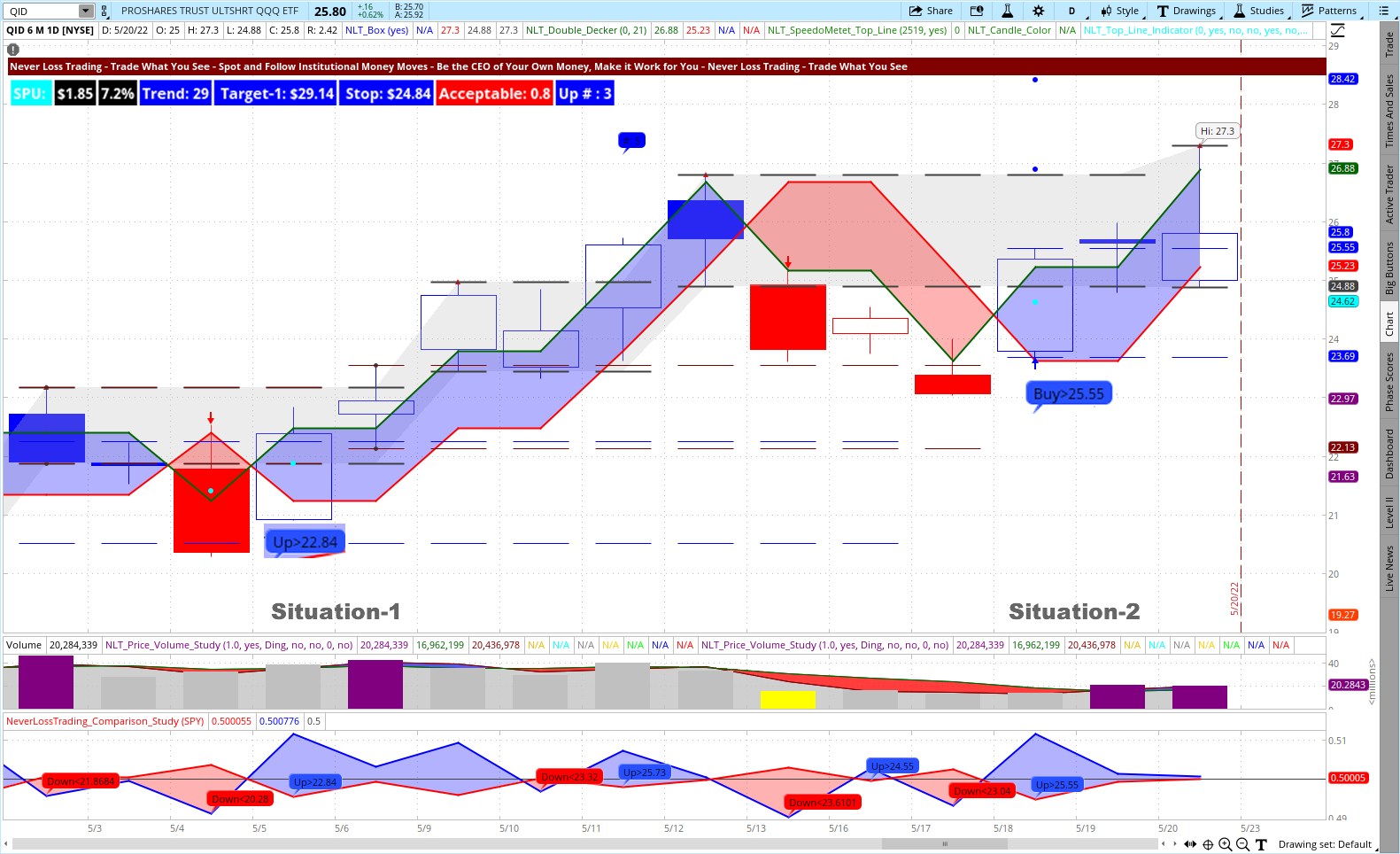
When technology is under pressure, QID, as a reverse ETF to the NASDAQ 100, offers excellent long trading opportunities:

QID on the NLT Daily Top-Line Chart

QID on a Daily NeverLossTrading Top-Line Chart

On the chart, we highlighted two trade situations:

Situation-1: Candles with a cyan dot, we call light towers, stand tall and point in a direction. In the highlighted situation, we have a change in command: buyers take over from sellers by showing two opposite-facing light towers in a row. Candle number five of the up-sequence is highlighted, and we like to take profit at the close of this candle, expecting other market participants to do the same. The trade was good for a 12% return on cash in four days.

Situation-2: An NLT Power Tower shows buy $25.55 and prints a target dot at $26.88, giving you a 5.2% return on cash in a matter of two days.
But which stock to trade and which strategy to apply, when and why?

With NLT Top-Line, you get market scanners and watch list indicators that help you find those opportunities we shared to act at crucial price turning points. We also do the work for you and provide those opportunities into your inbox through the NLT Alerts.

Trading is about gauging the probability of a price move with specifically defined:

  • Entry Decisions: going long or short when a system declared price threshold is surpassed
  • Exit Decisions: at entry, specify the exit, assuming that other market participants will start selling or covering their positions at such point.
  • Stop: Give the price development enough wiggle room to reach the target.
  • Risk/Reward: Based on your system probability, allow, for example, a maximum risk of 1.2-times the reward when you operate at a 65% probability of predicting the price move right.

The most critical decision is that you risk limiting your trade by either trading stocks combined with options or solid stock options by themselves. We are indeed teaching you chart setups to choose. However, you are dealing with a probability that is not 100%; hence, you will have losing trades; however, if you can limit your losers and harvest on winners, you are trading with an edge.

Instead of using the stop, concepts of trade repair gave us our brand name, but never stop loss trading was a bit lengthy.

Unfortunately, many retail traders do not limit their risk aside from applying a stop and on gaps and suffer through solid drawdowns.

When you are ready for a change and participate with our system in trading along with significant price moves,

contact@NeverLossTrading.com Subj: Demo.

NeverLossTrading is a concept that custom adapts to traders’ affinity, wants, and needs. We focus on acting at crucial price turning points and take our price move indications from several sources or market cuts. We have signals that check for price correlations, others for volatility or volume change. Combining NLT Systems gives traders a higher participation rate: more trades to participate per day, week, or month, where each system works as a standalone.

No trader is the same as another. We offer excellent customer service and adopt our systems to individual wants and needs, teaching and coaching at your best available days and times. We put together an overview of learning elements to take away from our training and coaching sessions:

Summary of learning elements:

  • Acting with a system probability > 65%
  • Mechanical rules for entry, exit, stop
  • Trade at perfect moments only
  • Consider overall factors, patterns
  • Risk and reward in an acceptable balance
  • Risk-averse trading
  • Holding positions to target
  • Do not add to losers
  • Stick with a trading strategy. Follow a business plan – action plan and financial plan
  • Trade for meaningful price moves
  • Systematic trading
  • Having a mentor to learn from

Learning Elements to Trading Success

Training Element of NeverLossTrading Programs

We also help you to journal your trades. Such a journal provides excellent feedback on how you are developing, and you find a perfect example in this article on our Blog: How to Control Your Trading Results

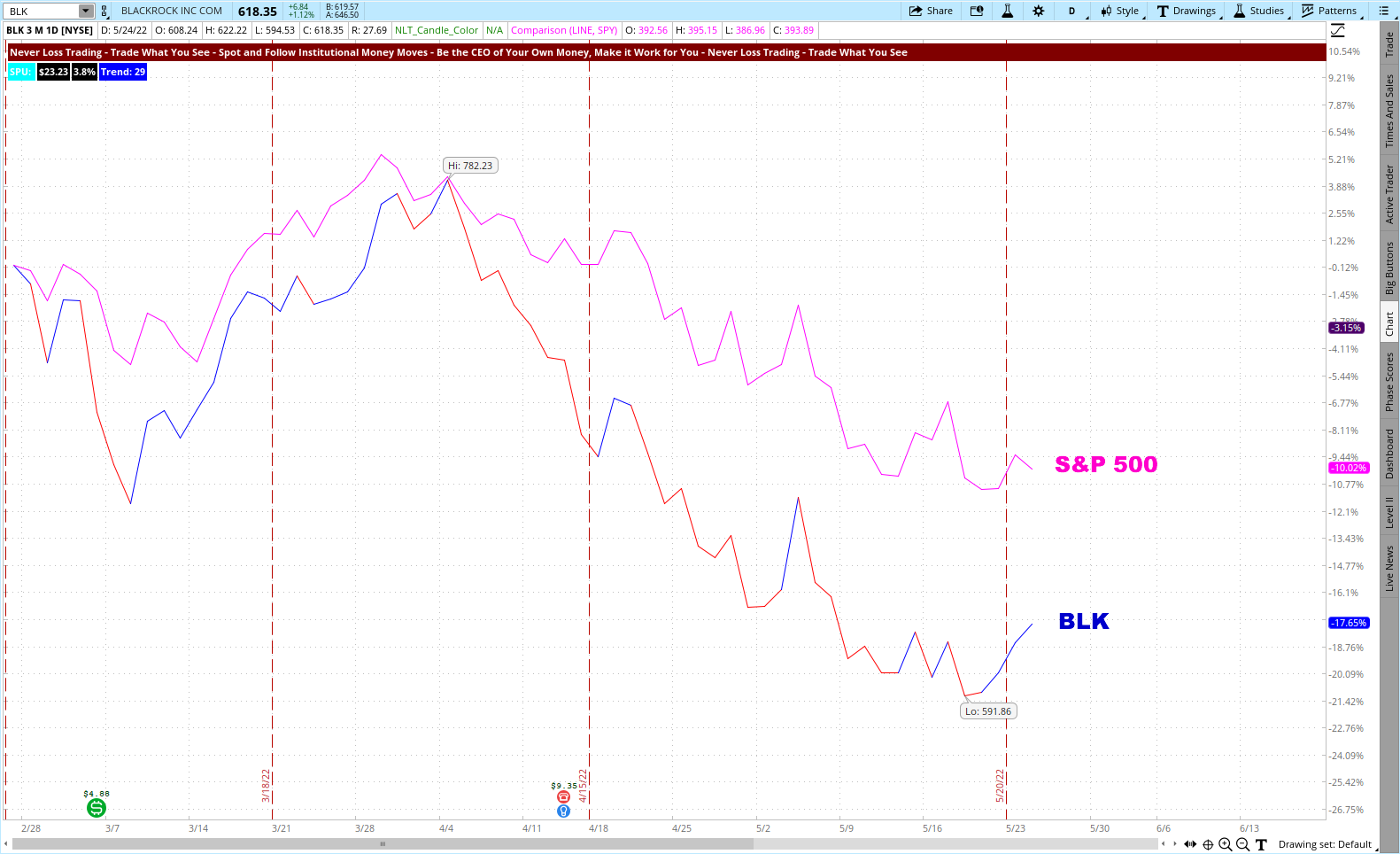
It is not the time for buy and hold; hence, if you do not change your trading strategy, your accounts will suffer substancial losses. The biggest professional fund investor is BlackRock, inc. After the financial crisis in 2008/2009 many institutional investors decided to let BlackRock (BLK) do the investment for them. When they would be successful in putting buy and hold portfolios together the share would be up, bu it is not: it pefroms below the S&P 500.

BLK and S&P 500 Three Months Development

BlackRock (BLK) development 2022

If professional investors cannot make money in the current market with buy and hold, why should you?

Hence, get ready to make a change to your decision making or system and investment strategies.

To succeed in trading, you must work with an experienced coach and learn as much about trading. Our #1 competitive advantage is the support and customer service we offer. We work one-on-one with you to specify what we teach to your specific wants and needs; hence, if your knowledge base is not expanding rapidly, you are doing something wrong.

Ongoing education and mentoring are crucial to longevity in this business.

Veteran traders have been through more ups and downs than you can imagine. So whatever you’re going through, experienced pros have probably experienced it already.

If you are ready to learn, meet us in a one-on-one session where we find out which learning program suits you best:

contact@NeverLossTrading.com Subj: Demo.

We are ready to share our experiences and help you build up your trading business. Trading is not a typical career, and you best learn from those who are long-term in this business to cope with the rollercoaster of the financial markets. We are here to help and provide feedback on what you might be doing right or wrong.

Make a change to your trading results, and we will find out which of our systems suits you best.

We are happy to hear back from you,

Thomas Barmann (inventor and founder of NeverLossTrading)

www.NeverLossTrading.com

Disclaimer, Terms and Conditions, Privacy | Customer Support