How disciplined day traders know when to wait, enter, and stop
Every market day offers opportunities, but not every opportunity deserves a trade. Successful day trading isn’t about being active every minute the market is open; it’s about recognizing when price action is clear enough to justify real risk, and when it’s too slow, choppy, or uncertain to offer a genuine advantage. Three questions decide that, every session: when to stay out, when a trade is actually worth taking, and when to stop for the day. A week from a live NLT reference account, September 14 through 18, walks through all three in practice.
When Should You Stay Out?
Staying out is a decision, not a default. It means recognizing sluggish price action, unclear direction, and signals that don’t meet the entry rules, and treating that recognition as actionable information rather than an excuse to force something anyway. Thursday, September 17, was exactly this: no setup that session met the standard, so no trade was taken. That’s not a gap in the week’s results. It’s the rule working correctly. A session with no qualifying setup costs nothing beyond the time spent watching, while a forced trade on a marginal setup risks real capital for a read the trader already suspected wasn’t strong enough.
When Is a Trade Worth Taking?
A trade earns the risk when several independent factors line up at once, not when any single one looks interesting on its own: a price threshold being tested, volume confirming real participation, directional agreement across the signal, and location inside one of NLT’s defined zones, areas where directional trades have historically been substantially more probable. The week’s first three sessions each show a different version of that alignment.
Monday, September 14: a penetration into the Euro Zone, one of NLT’s multiple zones where directional trades carry a meaningfully higher probability, traded with two contracts.
Tuesday, September 15: a top drop into the NLT red zone that defines the morning channel, read as a location-and-structure setup rather than a pattern in isolation.
Wednesday, September 16: a penetration into the morning channel itself, the same structural read applied to a different part of the session.
September 14 — Penetration into the Euro Zone
September 15 — Top Drop into the Red Zone
September 16 — Penetration into the Morning Channel
Not every well-reasoned setup pays off, and Friday, September 18, shows both sides of that honestly in the same session. One trade anticipated an upside channel break that never materialized, a valid read that simply didn’t play out, closed for a small, predefined loss rather than held hoping it would turn. The other, an NLT Light Tower on the bottom breakout of the NLT red zone, was the win that offset it. Taking both is what a probability-based process looks like in practice: the losing trade wasn’t a mistake; it was the method producing one of the outcomes it’s expected to produce some of the time, sized and stopped the way the rules called for.
September 18 — NLT Light Tower, Bottom Breakout of the Red Zone
When Should You Stop for the Day?
The last discipline is knowing when enough is enough, in both directions. The week’s goal was a familiar NLT benchmark: trade a single contract of E-Mini S&P 500 Futures, Crude Oil Futures, or Gold Futures to earn $1,000 in weekly income. A predefined daily budget and a maximum loss serve the same function from opposite sides: one keeps a good day from being given back chasing more; the other keeps a bad day from becoming a damaging one.
Three winning sessions built a solid cushion before Thursday’s disciplined no-trade day and Friday’s small, rule-bound loss. Neither of those cost the week anything that mattered; the goal was cleared by more than 60% with a day to spare, precisely because the losing trade was capped exactly where the rules said it should be, rather than allowed to run.
The Best Trade Is Sometimes No Trade
None of this week’s result depended on being right every time, or on trading every session. It depended on staying out when Thursday didn’t qualify, taking the trade when Monday, Tuesday, and Wednesday’s zone-and-structure setups did, and capping Friday’s loss the moment the anticipated break failed to show up. Patience, selectivity, and knowing when to stop turned out to matter as much as finding the entries in the first place, which is the whole idea behind trading what the chart shows rather than what a trader feels compelled to do with a screen open in front of them.
Ready to Learn When to Wait, Enter, and Stop?
Learn one-on-one how NLT zones, structure, and a daily budget work together.
Contact us: contact@NeverLossTrading.com — Subject: The Best Trade Is Sometimes No Trade
10 Expert Strategies for Smarter Trades, Better Risk Management, and More Confident Decisions
Ten powerful strategies to help you navigate, adapt, and capitalize on the fast-moving markets of 2026. Whether volatility spikes or trends emerge, this guide is built to keep you one step ahead.
Download your free collaborative eBook now and step into the summer with a sharper edge, clearer game plan, and the confidence to trade the heat of the moment.
How do you remove the guesswork from trading? It is the right question, and the answer has been hiding in plain sight for years. The challenge is not a lack of information. Markets generate far more data than any trader can realistically process. The real difficulty is identifying the critical price turning points — the moments where the best opportunities often emerge — before they are missed by the naked eye.
And even when those turning points appear, can you fully trust what you see? If you have traded for any meaningful length of time, you already know how difficult that can be. Most traders have been burned before.
This Is Precisely Why NLT Systems Exist
NeverLossTrading systems have been developed and refined over many years to identify and act on critical price turning points with algorithmic precision. By semi-automating the decision-making process, they help remove emotion, hesitation, and second-guessing from trading. In their place, you get confirmed, rule-based signals designed to support confident action through a clearly defined process grounded in real market dynamics and the natural shifts between supply and demand.
The NLT Price Move Model is built to guide traders across different styles, including day trading, swing trading, and long-term investing. When system-defined price thresholds are surpassed on the next candle, the system provides a clear signal to act. Exits following a 1-SPU price movement are marked directly on the chart, making them easy to recognize. In addition, the system highlights the appropriate stop or trade-adjustment level with a red crossbar, giving traders the structure they need to manage risk and respond intelligently.
NLT Price Move Model
You act on:
When system-specified price thresholds are surpassed in the price movement of the next candle for day trading, swing trading and long-term investing. The same principle guides you through all trading styles.
You exit after a 1-SPU price movement, and NLT systems highlight this with a dot on the chart, so you cannot miss it.
The system also specifies where to put the stop or trade adjustment price with a red crossbar, and you either exit with a loss or you apply NLT trade repair methods that enable you to prevent or reduce the loss or potentially turn a losing trade into a winner.
Day Trading
For day trading, we prefer highly liquid instruments such as the E-Mini S&P 500 futures contract. Our system highlights red zones where price pressure is elevated, helping traders focus on areas most likely to see turning points. For validation and execution, we combine price action with volume signals to clearly distinguish between highly probable and probable trades. We also prefer NLT timeless charts, where candles are built using system-specified price movement increments for added clarity and consistency.
E-Mini S&P 500 Example, April 30, 2026
Swing Trading
For swing trading, daily charts and volatility-adjusted charts provide the foundation for decision-making. These setups help identify opportunities with precision while keeping the broader market structure in view. .
MSFT on a Daily Chart March/April 2026
The chart shows multiple system-specified price move indications that reached the system-set target after being confirmed by the next candle’s price movement. Dots highlight the 1-SPU exit, which, in this example, was good for a return on cash of 2.4%, realized in one to five candles.
TSLA on a Volatility-Adjusted Chart, April/May 2026
Long-Term Investing
In long-term investing, we use weekly price action to guide holdings over a timeframe of one to ten weeks, allowing us to capture meaningful moves with a disciplined framework
AAPL on a Weekly Chart, January/May 2026
The chart shows three trading opportunities: short in January, long in February and April. All three trades reached their system-set target. However, we do not want to state that we always win: we deal with a probability and are never 100%.
Built for Traders Who Are Done Guessing
NLT systems are built for a specific kind of trader — one who has been around long enough to know what doesn’t work:
You’ve been burned by trend trading before — chasing moves that reversed the moment you entered
You want a strategy that can run in the background — without requiring you to watch every tick of the market
You want to simplify your trading — fewer decisions, clearer signals, more consistent results
The NLT system addresses all three through clearly documented rules, systems and strategies. The algorithmic structure means the strategy works without constant supervision. And its rule-based entries and exits replace complexity with clarity.
Take the Next Step
The guesswork ends when the system takes over. NLT systems have been doing exactly that for traders who decided they were ready for a better approach.
If you’re ready to see how algorithmic AI trading can work for your portfolio in 2026, start with a free consultation. No pressure, no obligation — just a conversation about what’s possible when you trade with the institutional flow, not against it.
🎯Discover a high-yield, low-risk trading concept built for
precision and performance.
At NeverLossTrading, we’ve
tackled the biggest challenges in day trading options—like low liquidity and
wide spreads—by handpicking two powerhouse ETFs: SPY and QQQ.
Backed by our proprietary NLT Timeless Concept, this strategy delivers
frequent trade opportunities, structured entries and exits, and a favorable
risk/reward profile through intelligent gamma positioning.
🚀 Curious how we do it?
We’ve prepared a complete concept document, including chart examples, trade
mechanics, and how to apply our proven system.
Trading in the financial markets comes with its fair share of challenges. From managing risk to dealing with emotional biases, traders face numerous obstacles that can impact their success. However, with the innovative solutions offered by NeverLossTrading, traders can navigate these challenges more effectively and achieve their trading goals. In this article, we will explore some common challenges traders face and how NeverLossTrading provides solutions to overcome them.
One of the biggest challenges traders encounter is managing emotions. Fear, greed, and impatience can lead to irrational decision-making and hinder profitability. We help traders base decisions on visible facts by letting the chart tell when to buy or sell, pointing out high-probable price turning points for day trading (opening and closing positions the same day), swing trading (holding positions for multiple days), and longer-term investing (holding positions for multiple weeks or months).
Our indicators signify the three dimensions of trading:
Dimension-1: Buy or Sell threshold to enter a trade, to assure other market participants trade in the same direction as you plan to.
Dimension-2: Trade target, high probability exit to close the transaction.
Dimension-3: Stop or trade adjustment level.
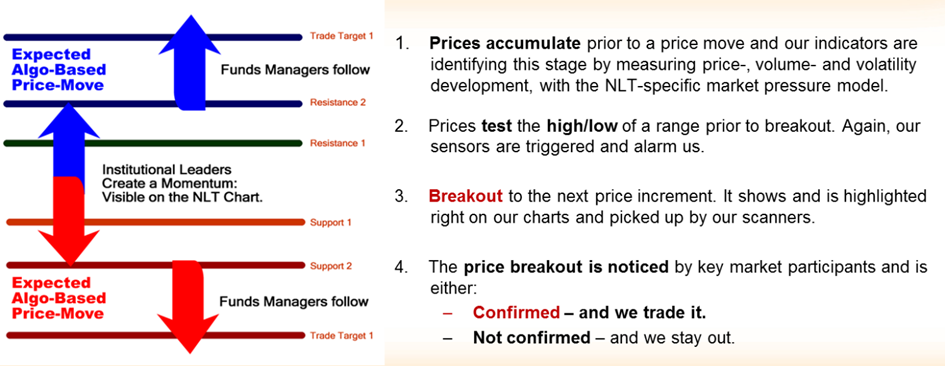
The crowd follows the leaders. Hence we like to share our price move model based on price change resulting from a supply and demand change.
NeverLossTrading Price Move Model
Now that we know how to specify the conditional entry, we need to specify the positive exit and use what we call the SPU (Speed Unit)
Definition of NLT SPU
After defining two variables, we must specify the stop or trade adjustment level.
What is a trade adjustment level?
It is the price to put the stop; however, instead of closing the trade at the stop price level, you adjust or add to the trade, repairing the trade instead of accepting a complete loss. The idea of Never Stop Loss Trading gave us our brand name, but we shortened it a little.
So where to place the stop?
By our research, a risk-to-reward ratio of 1.2 concerning is beneficial for several reasons:
Compensating for Uncertainty: There’s always a degree of uncertainty in trading. By employing a risk-to-reward ratio of 1.2, you provide a buffer that compensates for potential unexpected price movements or market volatility. This buffer helps account for the natural unpredictability of the financial markets
Improved Win Rate: A risk-to-reward ratio of 1.2 can contribute to an increased win rate. When the potential reward is slightly higher than the risk, successful trades impact your overall profitability more. Therefore, even if your win rate is not extraordinarily high, the favorable risk-to-reward ratio can help generate consistent profits over time.
Balancing Risk and Reward: Using a risk-to-reward ratio of 1.2 ensures that your potential reward is proportionate to the risk taken. In addition, it establishes a balanced approach to trading, where you aim to maximize your gains while managing and limiting potential losses.
Long-Term Profitability: A risk-to-reward ratio of 1.2 can contribute to sustainable profitability over the long term. Maintaining a balanced risk-reward profile creates a solid foundation for your trading strategy, promoting consistent returns and minimizing the impact of occasional losses.
You might think that a 1.2 times risk to reward is unfavorable; however, calculate with an average winning percentage of 70%. For example, when you aim to gain $250, you risk $300. Quantifying the equation with probability, the expectation value of this setup is $250 x 0.7 – $300 x 0.3 = $85. However, if you work with a narrow stop, you only win 20% of the time; for the rest, you get stopped, and the equation calculates as follows: $250 x 0.2 – $100 x 0.8 = -30, producing a negative expectation value with no chance of making money long-term.
Day Trading Example
Our preferred way of day trading is purely price action-oriented: candles are not drawn time-based, but price based, which specifies the concept’s name: NLT Timeless Trading. The chart shows multiple trading opportunities in the July 7, 2023, day session.
NLT Timeless Day Trading for E-Mini S&P 500 Futures
We acted on the Sell < $4,445,8 with a trade target to the opposite side of the gray price channel, producing an income of $550 per contract in about six minutes. You find multiple articles on our day trading concept on our blogs, but we also offer you a personal consultation session to see how our systems perform live.
Next, we take a swing trading chart and explain how our indicators help you to form fact-based decisions.
Home Depot (HD) on the Daily NLT Top-Line Chart
From left to right, the price development on the chart started in an NLT Purple Zone, indicating traders not to accept any signal. When directional price ambiguity is present: a robust indicator tells when you best stray out of trades. After that, we showed a period with no signals, ending in another NLT Purple Zone, where we do not accept trades. However, at the zone end, three different indicators announced a short-selling potential, which was not carried out to the target dot, but to the NLT Box Line. Rule-based trading might sound abstract now, but it is learnable, like traffic rules. For more details, please check our blogs or arrange a demo with us where we can share the details of our systems and rules.
We have been in business since 2008 and focus on your wants and needs in individual training sessions, so you can learn and apply what suits you best. In our years in business, we have not seen two traders of the same available time for trading, affinity to trading instruments, risk tolerance, return expectation, etc. There is a fit for every style and account: in case you trade out of an IRA where short selling is not allowed, we share out NLT Delta Force Options Trading Concept, which specifies:
Which strike price to pick
The time to expiration to choose
The maximum price to pay for an option
The minimum return to strive for (>65%)
Allowing you to participate in downside price moves from any account.
Long-Term Investing
Making sound longer-term trading decisions was not easy in 2023. We like the analyze the overall stock market development of the S&P 500, based on SPY (ETF)—our charts color upwards-moves in blue and down-moves in red. When the price movement has no up or down momentum, when red and blue mix, an NLT Purple zone is painted as a sign of directional price ambiguity: This was the case from the week of 1/16/2023 to the end of May 19, 2023. Hence, we did not commit to longer-term trades, even if we wanted to: day trading and swing trading were appropriate strategies.
The key for traders is to have advanced indications of what is happening and which strategy is applicable. The NLT Purple Zone indication is a great help for traders to choose the right strategy, and it announces when the time of ambiguity is over and directional longer-term trades are applicable. We take weekly charts to make this decision.
NLT Weekly Top-line Chart
Learning from the market and picking the right strategy is essential. The same counts for day traders: when trading short-term, you must be aware of important news events and combine them with the overall market view. We post critical news events on our Instagram channel.
Aside from rule-based trading, NeverLossTrading provides psychological support by emphasizing the importance of discipline, patience, and emotional control. Through its trade repair method, traders can minimize losses and stay focused on objective trading decisions, reducing the influence of emotional biases.
Sign up here to stay connected with our trading tips, articles and webinars.
When trading the financial markets, you meet professionals ready to win, and we are here to prepare you to find your edge and trade the financial markets with the help of our systems and strategies. As a private investor, your advantage is that you can open and close positions faster than institutions can. Still, you must find crucial price turning points that lead to a high probability of a directional price move.
Risk Management
Managing risk is crucial for long-term success in trading. Without proper risk management, traders can expose themselves to excessive losses. NeverLossTrading offers effective risk management techniques, guiding traders on position sizing, setting stop losses, and implementing trailing stops. By employing these strategies, traders can protect their capital and limit downside risks, ensuring sustainable trading outcomes.
We help our students to simplify technical analysis by providing a holistic approach that combines chart patterns, trend analysis, and market indicators. Traders are equipped with practical tools and methodologies to identify high-probability trade setups, helping them make informed decisions based on market trends and price action.
Executing trades at the right time and price can be challenging, especially in fast-moving markets. NeverLossTrading offers techniques for precise trade entries and exits, allowing traders to capture optimal returns. With its focus on high-probability setups and systematic approach, NeverLossTrading helps traders improve their trade execution and timing, maximizing their profit potential.
The financial markets are dynamic and ever-evolving, requiring traders to stay updated and continuously learn. NeverLossTrading promotes a culture of continuous learning, providing educational resources, webinars, and personalized mentoring. Traders gain access to a wealth of knowledge and expertise, empowering them to adapt to changing market conditions and enhance their trading skills.
Trading challenges are an inherent part of the financial markets, but with the solutions offered by NeverLossTrading, traders can overcome these hurdles and thrive in their trading endeavors. By addressing emotional biases, providing effective risk management techniques, simplifying technical analysis, optimizing trade execution, and fostering continuous learning, NeverLossTrading equips traders with the tools and knowledge needed for success. Embrace the solutions provided by NeverLossTrading, and embark on a journey toward consistent profitability and trading excellence.
To succeed in trading, you best work with an experienced coach. Our #1 competitive advantage is the support and customer service we offer. Veteran traders have been through more ups and downs than you can imagine. So, experienced pros have probably experienced whatever you’re going through. If you are ready to make a difference in your trading: We are happy to share our experiences and help you build your trading business. Trading is not a typical career, and you best learn from those who are long-term in this business to cope with the rollercoaster of the financial markets. We are here to help and provide feedback on what you might be doing right or wrong. Strive for improved trading results, and we will determine which of our systems suits you best. The markets changed, and if you do not change your trading strategies with them, it can be a very costly undertaking. Hence, take trading seriously, build the skills, and acquire the tools needed. Trading success has a structure you can learn and follow.
Thomas Barmann (inventor and founder of NeverLossTrading)
We’re thrilled to announce that our latest article, “The Significance of High Probability Trading,” has been published in the esteemed Traders World Magazine #89! 🌍📈
📖 Discover the Secrets of High Probability Trading
This must-read article delves into the world of high-probability trading and its profound impact on your trading success. Uncover the strategies, techniques, and mindset required to confidently identify and execute high-probability trades. 💼💰
🔍 Key Highlights:
✅ Learn how to spot high-probability setups based on technical analysis, market indicators, and price action.
✅ Master risk management techniques that safeguard your capital while maximizing profit potential.
✅ Gain insights into effective trade entry and exit strategies for capturing optimal returns.
✅ Understand the psychology behind high probability trading and how to maintain discipline in market fluctuations.
✅ Explore real-world examples and case studies showcasing the power of high-probability trading in diverse market conditions.
Don’t miss this opportunity to elevate your trading game and unlock the potential for consistent profitability! 💪
Remember, knowledge is power in the world of trading. Equip yourself with the insights and strategies to make informed decisions and succeed in trading.
Good trading,
Thomas Barmann (inventor and founder of NeverLossTrading)


 Contact us: contact@NeverLossTrading.com — Subject: The Best Trade Is Sometimes No Trade