🎯Discover a high-yield, low-risk trading concept built for
precision and performance.
At NeverLossTrading, we’ve
tackled the biggest challenges in day trading options—like low liquidity and
wide spreads—by handpicking two powerhouse ETFs: SPY and QQQ.
Backed by our proprietary NLT Timeless Concept, this strategy delivers
frequent trade opportunities, structured entries and exits, and a favorable
risk/reward profile through intelligent gamma positioning.
🚀 Curious how we do it?
We’ve prepared a complete concept document, including chart examples, trade
mechanics, and how to apply our proven system.
We share a simple options trading strategy, helping you to position where big money invests short-term.
Options trading offers you three significant advantages:
– You only invest a fraction of about 1% to 5% of the share price.
– You operate with leverage when your trade works.
– You can limit your maximum risk by choosing an adequate strategy
The big question is: how to find such options trading opportunities and capitalize on them?
NeverLossTrading Options Strategy
Successful options trading needs a solid knowledge basis; however, today, we provide a shortcut in peaking over the fence and copying what institutional investors do.
We let our scanners venture through stocks with liquid option chains daily, highlighting happenings according to our specifications.
Let us share an example: End of the day on March 11, we created the following report for March 14 (a Monday), highlighting two options trading opportunities:
BIDU
SBUX
Our NLT Options Alert is comprehensive, reporting the details of the trading day:
Highlighted Options for March 14, 2022 by NeverLossTrading
As you see, it has a lot of details, but let us magnify into the table:
Highlighted Options for march 14, 2022
For BIDU, three options trading opportunities are highlighted:
The March 18, 22, $125 Calls that were trading between $3.80 and $9.19, closing at $4.09
The March 18, 22, $130 Calls that traded between $2.18 and $9.50, closing at $2.45
The March 18, 22, 110 Puts that ranged between $0.52 and $4.10, closing at $4.09
When you see such indications, how to read and act on the happening?
A typical institutional trading strategy is selling naked Puts and buying Calls. The advantage of this strategy is that you are collecting premium and time decay works in your favor by selling Puts. On the other hand, when buying Calls, time decay negatively impacts you, but you want to achieve a leveraged income from solid directional price moves.
What did our indicators tell about the current price situation of BIDU?
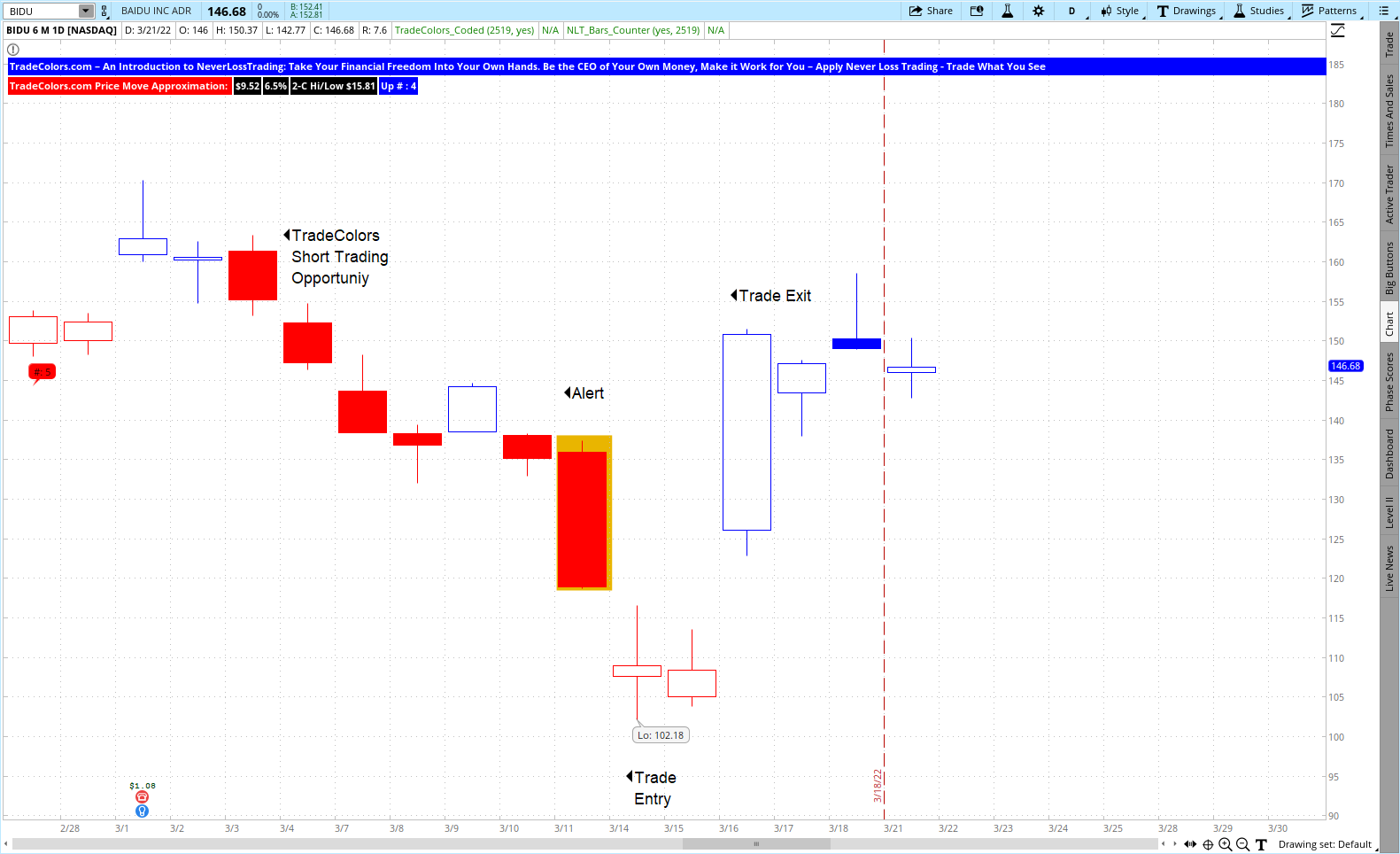
The stock was in a downtrend; let’s check the TradeColors.com chart. Tradecolors.com is our introductory system to algorithmic trading with human interaction. Trade situations are specified by the first two same color candle combinations when the high of the second blue candle or the low of the second red candle is surpassed in the price movement of the next candle.
We let the chart tell when to buy or sell: Trade what you see!
BIDU on a Daily NLT TradeColors.com Chart
BIDU Highlighted NLT Trading Opportunity
The chart shows:
On 3/4/2022, the TradeColors.com indicator highlighted a short selling opportunity that came to target on 3/11/2022.
For March 14, 2022, our alert showed an opportunity to copy the institutional investment of 11, 2022: buying $125 and $130 call options and selling them on March 16, 2022. The table below shows the calculated results for the Call options. We do not advise to participate in naked Put strategies; however, in the example, they expired worthless:
BIDU Options Trading Return
The example demonstrates the power of the leverage options trading can give you; however, you need to be aware of the opportunity. Short-term options are prone to time decay, and such, if you are wrong in your directional assumption, their value deteriorates quickly.
The second stock highlighted was SBUX (Daily Chart)
SBUX Highlighted Trading Opportunity by NeverLossTrading
Here is the impact the price development had on the Call options to buy:
SBUX Options Trading Return
A dream many options traders have; however, we want to make you aware that there is no risk-free trade, and on short-term options, theta or time decay can quickly take your money away. Hence, options trading needs a model or system that helps you to invest at crucial price turning points. The strategy of following institutional investments is just one way of trading along with price moves that you can learn in our mentorships.
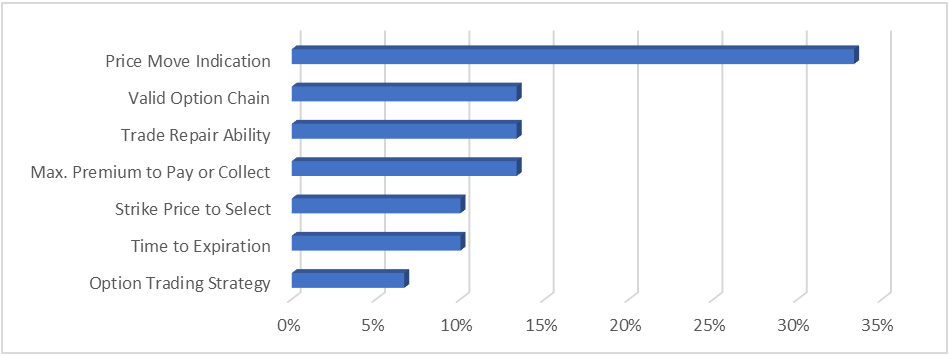
Options traders have to find answers to multiple questions, reaching from a system-based price-move-indication to choosing the appropriate options trading strategy.
Importance of Option Trading Decisions
Dimensions of Options Trading Decisions
The overview shows multiple factors to consider and let us explain them:
Price move indication determines to 33% the outcome of your options trading endeavors; however, there are many other decisions to be made with a similar impact on your options trading success.
A valid options chain is an essential factor to consider and leads you to only focus on liquid options with tight bid/ask spreads.
Trade repairability is intertwined with a valid options chain and includes picking a trading strategy that allows for a repair when the trade develops in the opposite direction.
Our systems determine if the premium to pay or collect is in spec., and you trade with the odds in your favor. This way, you never pay too much or collect too little and trade with the odds in your favor.
There are many theories of which strike price or delta to pick. We developed our own mechanics and rules, helping you to participate with the highest leverage in anticipation of a minimum 1-SPU price move.
Our systems and strategies determine the maximum expected time in the trade to come to target, and in relation to this, you will always know which time to expiration to choose.
We mainly focus on buying Puts or Calls on the side of the options trading strategies; however, we work with debit or credit spreads when options are overpriced.
Summary of our Options Trading Imperatives
Option Trading Imperative
Answer
Price Move Indication
NeverLossTrading System
Valid Option Chain
Statistics of bid/ask spreads, daily volume, open interest
Trade Repair Ability
Our research and experience shared in our mentorships
Max Premium to Pay or Min Premium to Collect
NLT SPU-Measure-Based decisions (Algorithm)
Time to Expiration
NLT Signal-Based
Option Trading Strategy
Chart-Based: Max. premium to invest or risk to accept
Summary of Options Trading Dimensions
Producing consistent income from trading and investing is a process. We provide systems, strategies, and a game plan, helping you develop yourself into the trader you want to be.
If you are up for learning this, let us get super interactive, and we will meet with you in a one-on-one meeting online to test how our systems can help you to answer the options imperatives.
Summary:Options trading offers a high leverage, limited risk strategy to participate in stock price moves. There are some rules to learn to successfully day trade Put and Call options, and we want to share a step-by-step approach to follow.
Options allow you to invest only a fraction of the underlying stock costs: In the concept we share, the investment volume for an options trade compared to 100 shares varies between 0.2% to 3% of the stock price.
Picking an example: Buying 100 SPY Shares requires a cash investment of $47,700. If you day trade from a margin account, your associated cash for the trade is about $12,000. Using our day trading options strategy, one risk unit to control 100 shares comes down to about $180, making day trading options very attractive; however, there are some rules to comply with.
Options Trading NeverLossTrading Style
FINRA and SEC regulate options trading, and you need to fulfill pattern day trading regulations (PDT):
You meet the minimum PDT criteria if you make more than three day trades in five business days.
As a PDT, your margin account needs to hold more than $25,000. If the total value of assets falls below that figure, you will not have any buying power.
What Constitutes A Day Trade?
A day trade is simply two transactions in the same instrument in the same trading day, such as buying and consequent selling of a stock. The two transactions must offset each other to meet the definition of a day trade for the PDT requirements. So, if you hold any position overnight, it is not a day trade.
If you do not reside in the U.S. or hold a U.S. brokerage account, you might get a break on this. For example, there are no pattern day rules for the UK and Canada, and we are unaware of those in other nations. These rules are set by the US FINRA and therefore apply only in the U.S.
Hint: Always check with your broker; they might even impose more stringent rules for PDT. Most brokers offer several different accounts, from cash accounts to margin accounts, and each account comes with its own rules and regulations you will need to follow.
When your day trading account holds less than $25,000, day trading Futures or FOREX is your choice, and we offer unique systems and mentorships to share how this is done best.
Now that we shared the rules and regulations that guide options day trading activities, let us focus on the how’s and why’s:
How to day trade options?
As an algorithmic trading house, we specify and follow mechanical rules of how to day trading options:
The price movement of the underlying stock specifies entry and exit. When trading options, never work with a stop on the option; only define the stop-exit by a price point of the underlying stock chart. Same on the exit at target.
After entering an options trade with a limit order, you define conditional OCO (one-cancels-the-other) orders based on the underlying stock’s price points, determining your exit. Our systems define the maximum price to pay.
The system and indication also define the maximum holding period as a number of bars/candles: you exit if the trade is neither at the targe nor stop level.
In the concept we share today, we are not trading time-based; decisions are only price-based, and the system defines the price movement you focus on.
We use simple day trading strategies: buying weekly options: Puts (expecting the share price to drop) and Calls (expecting the share price to rise) based on the NLT Timeless defined price-move-value at a system-defined delta.
We are not day trading for price movements of the underlying stock below $1.
We share which stocks best to trade with this concept based on daily volumes, open interest, bid/ask spread.
Now the big question:
Why consider day trading options?
There are several reasons:
When prices fall, the ability to borrow stocks from your broker for short-selling is often limited. The terms used are HTB (hard to borrow) and ETB (easy to borrow), and the status stock-by-stock fluctuates by broker and situation.
Stocks underlie the uptick rule, which is a trading restriction that states that short selling a stock is only allowed on an uptick: If prices radically fall, your short-selling order will not be filled.
You are not allowed to short stock in IRA or Cash Accounts, while you can trade their options by applying for option level-2 (just some paperwork).
Where is the advantage of day trading options?
Let us share what day trading with the NLT Timeless concept can give you:
Aiming for a ≥ 65% return at pre-specified price situations on flexible risk units at high probability trade setups.
Working with risk-limiting investments only.
You are investing a fraction of the stock price.
Uptick rules and HTB do not limit your trading.
Learnable rules are applicable for multiple stocks, and we share where to best act and how.
Let us explain by a chart:
SPY Day Trading Chart
SPY on the NLT Timeless Trading Chart
At the chart, our indicators spell out price thresholds: Buy >, Sell <, and you trade when those are surpassed in the price movement of the next candle. Dots define positive exit levels and red crossbars’ potential stops. So look at the chart and understand why we say: let the chart tell when to buy or sell!
In the above situation, trading SPY stock on four times margin would have given you a return per trade, shy of 2%, with the NLT Timeless Concept and day trading options ≥ 65%.
Why and how does this work?
There are multiple ways to decide on a trade. When using technical analysis, you have the following variables to determine a potential price move setup: Price change, volume change, Volatility change or a combination of those
The majority of trades are determined by a change of one of those variables over time: Moving averages would be a typical example for tracking and deciding based on an asset’s price movement over time. You most likely experienced that you predicted the future price move; however, on a counter-price-action, you got stopped, and you were out of a trade before it commenced in your predicted direction: Producing a loss instead of the desired win.
Like in a chess game: Acting with predictable moves is rarely a winning strategy.
If you use a dynamic, less predictable entry, exit, and stop definition, you certainly have the chance to increase your trading accuracy.
With NLT Timeless Trading, time is taken out of cohesion. This will make your decisions less predictable; however, the stronger argument of the idea is:
We are helping you to simplify your trading decisions by specifying conditions to execute bracket or OCO orders along with the price movement of underlying assets.
The system works for all asset classes: Stocks, Futures, and FOREX.
What we casually named variables are, in reality, results of an underlying change in supply and demand. In the base economic principle, price is a result of a change in supply and demand. Time is not considered a determining factor. The model assumes that markets regulate themselves instantaneously by economic principles.
Supply and Demand Correlations
Price results by a Change in Supply or Demand
The above graph gives a relation of the quantity offered and the resulting price. In the current situation, additional demand for a stock at $100 occurs. If no additional supply occurs, the equilibrium will move up to match supply and demand at $110.
The typical problem for a trader is: In hindsight, you know what happened, and we want to help you predict the future price happening with high predictability and frequently by our systems and concepts.
Money flow accepts price as the resulting variable of a change in supply and demand and specifies potential price move setups with clearly defined:
Entries (price threshold)
Exits (targets)
Stops (wrong assumption)
With our systems and strategies, we want to help you to higher accuracy:
Only accepting a trade when the direction is confirmed
Exiting at a pre-defined target, prevening for the price to pull back and taking your profits away before you realize them
Choosing an adequate stop, so you are not taken out of a trade by a too-tight stop and keeping reward and risk in a meaningful balance.
A Quick tip: buyers and sellers move the market; whoever has the upper hand moves the market in their direction.
This writeup focuses on day trading, and we refer to swing trading or longer-term investing in separate documentation.
By the NLT Timeless Concept, we simplify life for you and let the chart tell when to buy or sell, specifying all decision making dimensions at once:
Entry Conditions: Execute buy-stop or sell-stop orders at pre-defined price thresholds at assumed probability, always knowing the maximum price to pay for an option and which strike to pick.
Exit Condition: When is the target reached
Stop Condition: When are you wrong and exit
Risk Management: Defined and concluded in the NLT Options Trading Strategy
When day trading for pre-defined price moves, positions are kept open for a couple of bars/candles but always close the same day.
Clients say this: “Now I feel comfortable, walking away from the trade without feeling the need to control it.”
Would it not also comfort your trading decisions?
Let us show you chart examples using a combination of NLT Indicators on the NLT Timeless chart.
TSLA, Day Trading on the NLT Timeless Chart
TSLA on the NLT Timeless Day Trading Chart
Chart Analysis
Again, the chart speaks for itself, and our system offered multiple intraday trades with an exceptionally high win rate.
Entry conditions: when the spelled out price threshold is surpassed in the price development of the next candle:
Stops at the red crossbars or five bars in the trade without reaching the target or end of the day.
Never enter a trade at the exit candle: stop or target.
When this caught your interest as a day trader, ask us for a live demonstration:
With the help of our systems, we help retail traders to decide at trade entry for the five significant challenges they face to prevent the common mistakes often made:
Trade entry decisions (when to trade)
Exit decisions (where to take profit)
Stops (where to place them)
Maximum time in a trade (specified by the signal)
Risk to reward (only trade at favorable setups)
The Basis of Trading Decisions by NeverLossTrading
NLT Timeless Day Trading is just one example of what you can learn in our mentorships.
We work one-on-one only and taught many traders to get independent in more than ten years in business.
Let us add another example of a widely traded and held stock: AAPL.
AAPL, Day Trading on the NLT Timeless Chart
AAPL on the NLT Timeless Day Trading Chart
Multiple indicators found a trade situation for going long at 11:15 a.m. EST. The red crossbar signified the stop, and it was not challenged until the trade came to target (gray dot on the chart) at about 3 p.m. EST. When trading the stock, you aimed for a 3% return on margin. By trading NLT-specified Call Options, you were striving for a 65% return on a minimum investment level of the price of one share. For more:
Knowledge is power; however, the most common trading knowledge is not common knowledge. Let us share what is needed in today’s markets by inviting you to read the Traders World Magazine #82 for free.
Traders World Magazine
You will find several articles explaining what is needed for trading our days.
This white
paper shows how we combine NeverLossTrading indications and options trading activity
for finding and following trading and investing opportunities when they develop
intraday.
We are
blogging and sharing content for more than ten years, and we helped many
traders and investors to produce consistent income from the financial markets.
With our
systems and indicators, we are tracking institutional money moves and trade
along with those by finding and acting on high probability setups with the goal
of ≥ 65% accurate directional prediction.
Let us give
you an example of how our systems spell out opportunities on the chart to spot
and follow:
AAPL
Weekly NLT Top-Line Chart, Feb. to Aug. 2020
Even so,
reading and operating with our indicators needs to be learned, the chart
demonstrates how our system points out opportunities at key price turning
points and along with the price development of the observed asset: in our case
AAPL.
In the NLT
Options Trading Alert, we combine NLT indicator readings and options trading
activities, highlighting where our systems find significant changes in supply
and demand intraday. There is no fixed reporting schedule, the trading day and
happening defines when the alerts are generated:
First
reports come out around 10 a.m. ET forward.
End
of the day alerts, around 3 p.m. to 3:30 p.m. ET.
-We
only share reports when referring changes in supply and demand are identified. When
nothing happens, no alert will be generated and shared.
-An
alert based on the end of the day numbers will also be generated and shared.
-Only
shares with meaningful option trading conditions are considered (tight bid/ask
spreads, minimum volume and open interest requirements we set).
With the NLT
systems, we are operating on confirmed signals only: Daily signals, for example,
have to be confirmed in the price continuation of the next day.
By combining
early indicator readings and options trading activities, we are opening positions
without confirmation on the day of occurrence, and we were able to achieve high
probability results ≥ 65%.
In summary: The
goal of this new alert service is to inform you intraday about happenings: The
actual price move of the underlying, combined with the intraday options
activity, proposes early entries into developing directional price moves.
Options
trading with the right strategies provides:
-Fantastic
return opportunities.
-Risk-limited
trading: Limiting the trading risk, either to the premium paid, when buying
options, or to the width of the spreads, minus the premium received on credit
spreads.
We are a big
proponent of trading risk-limited only; it builds the basis for every
successful trader by preventing drawdowns.
Could you
have traded the stock instead of the option on the spelled out opportunities?
Yes, because
we traded directional only, and such trading the stock instead of the option
would have lead to the same positive results: 72% winners over 28% losing trades.
Before
launching this alert service, we tested the NLT Options Trading Alert for three
months, with the following results:
·Between June 4 and August 25, 2020,
we conducted 69 trades in 58 trading days: 1.2 transactions per day. Of those,
60 positions are closed, and nine are still open.
·Of the 60 closed trades, 43 (72%)
were winners and 17-times we lost (28%).
·The average return of the winning
trades was 74% of the investment made. The average loss was 65% of the
investment made.
·On the first pass, we kept the
maximum risk-unit per trade below $500, and such we left put or call buying
opportunities for high-value shares like TSLA out, except spread trades allowed
to participate with the set risk limit.
In summary:
We were winning more often than we lost, and we produced a higher return and
lower loss average per trade:
A success
principle in which we believe in!
Here is an
overview of the stock symbols we traded (options of some of the listed symbols
were traded multiple times):
Stock
Symbols of the Options Trades Conducted
The listed symbols were not the only trades we
conducted; NLT offers multiple alert services from which we choose and
execute opportunities for all asset classes: stock, options, futures, and
FOREX.
All traded symbols provided substantial daily open interest and volume: an
imperative for meaningful options trading.
The average
time in a trade was 11 days, with the followingdistribution:
Average
Days in a Trade
About 25% of
the trades were adjusted, mostly by rolling positions forward:
-40%
of the losing trades were adjusted
-12%
of the winning trades were adjusted
By producing
an average 74% return over a 65% average loss, the adjustment method provided
an edge. Options trading adjustment methods are taught at our mentorship
programs.
Producing
consistent income from trading and investing is a process, and we provide
systems, strategies, and a game plan, helping you to develop yourself into the
trader you want to be.
If you are
up for learning this and using the NLT Options Alert, let us get super
interactive on multiple levels:
-Level-1: Write
us an email that you want to test the end of the day NLT Options Alert to see
if you can get value out of it, and it will end up in your inbox at the end of
the day or early next day. Subj.: NLT Options Alert Only.
-Level-2: We interact
with you and share opportunities we find intraday and at the end of the day.
When you are up for this, we want to have content-filled conversations, and
such we want to offer this to ten individuals only. For being able to act on
the opportunities we share, options trading experience is of help. If you want
to learn how to work with our systems, indicators, and strategies, we are happy
to help you with one of our mentorship programs (incl. software, teaching,
coaching). For being part of Options Level-2, please email us: Subj.: NLT
Options Exchange.
No, there is
no charge, and no credit card is needed to participate. When you like our service,
we will make you an offer, and you decide if you accept it or not. For you to
participate, a legit name and email address is needed: