Spot and Trade Institutional Money Moves

Algorithmic Trading with Human Interaction for:

Day Traders, Swing Traders, Long-Term Investors

Showing posts with label Retirement Trading. Show all posts

Saturday, April 11, 2026

RETIREMENT INCOME TRADING


How to Produce Additional Income and Stay Sharp After Retiring

The Retirement Reality Most People Don't Expect

Retirement should be a time of freedom and fulfillment. But for many, it quickly becomes an unexpected challenge — not just financially, but mentally. Without the daily cognitive engagement and purposeful routine that work provides, the mind and body begin to fade faster than most people anticipate.

Research shows a troubling pattern: retirees can lose up to 55% of their physical and cognitive capacity within just seven years of leaving the workforce. Memory, decision-making, and problem-solving speed — all measurably decline when they are no longer exercised through meaningful daily challenges.

But this trajectory is not inevitable. The retirees who thrive — mentally, financially, and in terms of quality of life — share one common trait: they stay engaged with structured, meaningful challenges that continuously exercise their cognitive faculties.

One of the most powerful and often overlooked ways to do exactly that is through disciplined, systematic trading.

Cognitive Decline Post-Retirement

Who Is Already Trading in Retirement?

Retirement and investing have always been closely linked, but a growing number of retirees are moving beyond passive savings vehicles into active trading. Understanding how retirees currently engage with financial markets provides important context for the opportunity ahead.

Account Type% of RetireesPrimary Purpose
Active Trading Accounts~14%Supplemental income, market engagement
IRA (Traditional & Roth)~42%Tax-advantaged retirement savings
401(k) / Rollover Accounts~44%Employer-sponsored long-term savings

The majority of retirees hold their savings passively — relying on index fund returns, bond ladders, or advisor-managed accounts. While these approaches preserve capital, they typically yield returns that barely outpace inflation after fees, taxes, and the rising costs of healthcare and living.

The 14% who maintain active trading accounts represent something fundamentally different: retirees who have chosen to take an active role in generating income from their savings — and in doing so, they also preserve their mental sharpness as a secondary benefit.

For those who want to consistently generate income above and beyond what passive market returns provide, active trading — approached with the right methodology — offers a compelling alternative.

Trading as a Structured Mental Gymnasium

The transition from a career to retirement often means more than leaving behind a paycheck. It means losing the daily cognitive workout that keeps your mind at its best. Strategic thinking, pattern recognition, risk assessment, and rapid decision-making — these mental muscles atrophy without regular use.

Trading provides exactly the kind of structured, purposeful mental engagement that counteracts this decline. Unlike passive activities such as television watching or casual reading, trading demands:

  • Daily analysis of charts, market conditions, and economic signals
  • Pattern recognition across multiple timeframes and asset classes
  • Disciplined decision-making under real conditions of uncertainty
  • Ongoing learning — economics, global events, sector trends
  • Emotional regulation — patience, discipline, and resilience

Think of it as chess combined with current events: strategy meets real-time information. Every trading day is a new puzzle. Every position managed is a decision exercised. Every market cycle studied is a new lesson learned. These are not just trading skills — they are life skills that enhance cognitive function across every dimension of your daily life.

Generating Income Above Average Market Returns

For retirees who want a solid, continuous income from their savings — not just the average stock market return of 8–10% annually — active trading with a high-probability system offers a fundamentally different proposition.

Passive Investing — What You Get Average S&P 500 annual return: ~8–10%Subject to full drawdowns in bear marketsNo ability to profit in declining marketsNo income generation — only price appreciationNo active learning or cognitive engagementActive Trading with NLT — What's Possible Defined entry and exit at specific price levelsAbility to trade both long and short positionsStructured risk management protects capitalIncome generated independently of market directionDaily cognitive engagement — mental sharpness maintained

The key distinction is not about taking more risk — it is about taking structured, defined risk with clear parameters. A high-probability trading system like NeverLossTrading eliminates guesswork, replacing it with rules-based logic, precise signals, and a clear methodology for managing every trade from entry to exit.

The result: retirees who apply a disciplined trading methodology can aim to generate consistent supplemental income regardless of whether the broader market is rising, falling, or trading sideways.

7 Things No Other Trading Educator Offers

Most trading education companies offer courses, live trading rooms, and general guidance. NeverLossTrading is structurally different — in ways that competitors cannot easily replicate. These are not marketing features. They are core architectural advantages built into how NLT operates.

True 1-on-1 Mentorship — Every Session vs. chat rooms, group live streams, 500-person trading rooms Others:  Group sessions where your specific questions go unanswered. One moderator, hundreds of students. NLT:  Every NLT session is private, personal, and recorded for your replay. You work directly with an NLT expert — not a moderator, not a crowd. Capacity is deliberately limited to protect session quality.
Algo Signals With Exact Entry Prices Painted on Your Chart vs. vague directional signals, lagging indicators, no price levels Others:  Arrows and alerts with no price level — you still have to guess when and where to enter. NLT:  NLT algorithms display the exact threshold on screen — for example, 'Buy > 551.01'. No reading between the lines. No ambiguity. Trade what you see.

NLT indicators pinpoint high probability trading opportunities — providing clearly defined entries and exits that guide traders through every market phase.

SPY on a Weekly NLT Multi-System Chart

The NLT weekly chart calls critical market turns, and we only follow an indication when the price thresholds for buy > and sell < are met in the next candle's price movement, following a model where we want to trade when strong institutional buying or selling occurs. Our systems generate signals at multiple levels, providing a constant array of trading opportunities that we also express as NLT Alerts to our subscribers.

On the weekly NLT Multi‑System chart, our algorithms highlight decisive market turns. We only act when price thresholds for buy > or sell < are triggered by the next candle’s movement — a disciplined approach designed to capture trades driven by strong institutional activity. Each system operates at multiple levels, producing a continuous stream of actionable signals that we share with our subscribers via NLT Alerts.

“We let the chart tell when to buy or sell!”

Trading Time Frames:

  • Weekly charts reveal long‑term investment opportunities, with positions typically held one to ten weeks.
  • Volatility‑Adjusted charts identify trades lasting one to twenty days.
  • Daily charts support tactical entries designed for one‑ to ten‑day trades.
  • Timeless charts serve day and swing traders seeking precision entries without time‑based constraints.

SPY on a Daily NLT Multi-System Chart

How our indicators called the market turn!

The chart above illustrates how our indicators signaled a short setup between March 12 and 30, followed by a bottom turn call on March 31, which was confirmed on April 1, 2026. This sequence triggered a two‑SPU upward expansion, marking a forecasted counter‑move zone rather than a continuation signal — a textbook demonstration of how our system anticipates momentum shifts before they unfold.

Trade Repair — Not Stop Loss The founding NLT philosophy — unique in the industry Others:  Stop loss triggered → position closed → capital lost. Move on and accept the loss. NLT:  Trade moves against you → repair protocol activated → position managed toward recovery. NLT teaches how to fix a losing trade — not just cut it.
Free Professional Platform + Real-Time Data Included vs. $50–$300/month charges for platforms and data feeds Others:  Most educators charge separately for platform licenses, data feeds, and software tools — costs that add up to thousands per year. NLT:  All NLT software is installed on a server accessible from any computer worldwide. Real-time data for all US exchanges is included at no extra cost. Use your existing broker — no account switch required.
Up to 50% Tuition Credit Toward Any Program Upgrade vs. full repayment required when moving to the next level Others:  Your previous tuition is sunk cost. Starting the next level means starting over from zero. NLT:  Your investment rolls forward. Up to 50% of what you paid at any NLT level applies as credit toward an upgrade — from TradeColors.com to NLT Income Generator to NLT Top-Line. Your commitment is rewarded.
17+ Years Operating — Zero FTC Complaints vs. FTC enforcement action for deceptive income claims Others:  Multiple prominent trading educators have faced FTC lawsuits, cease-and-desist orders, and penalties for deceptive income claims. NLT:  NOBEL Living, LLC was founded in 2008 and has operated with full regulatory integrity for 17+ years. No FTC lawsuits. No deceptive income claims. No regulatory complaints. Transparent and education-first from day one.

Experience Makes the Difference:

  • Follow our proven, rule‑based trading systems.
  • Benefit from concepts customized to your individual goals and trading style.
  • Engage with us throughout your learning journey as we share and discuss.
All Asset Classes — One Unified Methodology vs. specialization in a single market: stocks only, futures only, or forex only Others:  Learn one system for stocks, then need a completely different system for options or futures. Your knowledge doesn't transfer. NLT:  The same NLT system — the same indicators, the same entry/exit logic — works across every market. Learn it once, apply it everywhere.
StocksOptionsFuturesForexCommoditiesTreasuriesETFs

The Dual Benefit: Income and Cognitive Vitality

What makes trading uniquely suited to retirement — when approached with the right structure — is that it delivers two distinct benefits simultaneously.

Financial Benefit Supplemental income above passive market returns. Cover unexpected healthcare expensesFund travel and new experiencesProvide a financial buffer and peace of mindGenerate income in any market environmentCognitive Benefit Mental engagement that counteracts cognitive decline. Daily analytical thinking and pattern recognitionStructured decision-making under uncertaintyContinuous learning — markets, economics, global eventsConfidence, independence, and sense of purpose

A Personalized Trading Business Plan — Built for You

NeverLossTrading does not apply a one-size-fits-all model. Every retiree comes to trading with a different financial situation, schedule, risk tolerance, and set of goals. The NLT approach begins with understanding exactly where you are — and building a trading plan tailored precisely to your life.

What Your Personalized NLT Trading Plan Includes • Your specific income objective — how much you want to generate monthly or annually • Asset classes best suited to your capital level and schedule • Time commitment — whether you trade 30 minutes per day or several hours • Risk tolerance — position sizing rules that protect your retirement savings • Clear rules: when to trade, when to stay out of the market, and how to approach each opportunity • Defined protocols for trade management — including repair strategies for adverse moves

The learning process is structured like personalized coaching — think of it as one-on-one golf lessons rather than a generic video course. You don't just watch someone else trade. You work directly with your NLT mentor, apply the methodology in real market conditions, and build competence through guided practice.

Every session is recorded for your replay. Every strategy is documented in a framework you can reference independently. And as your skills develop, NLT grows with you — from foundational concepts through advanced multi-timeframe strategies.

Your Retirement Years Should Be Your Sharpest

The question is not whether you can afford to explore active trading in retirement. The question is whether you can afford not to. With cognitive capacity, financial security, and quality of life all interconnected, finding structured, meaningful challenges is not optional — it is essential.

Trading through NeverLossTrading offers more than extra income. It offers engagement, purpose, continuous learning, and the satisfaction of developing a genuinely valuable skill. It keeps your mind sharp. It provides structure where retirement can otherwise offer aimlessness. And it gives your savings the opportunity to work harder — on your terms.

Ready to Take the Next Step? Contact NeverLossTrading to discuss how the NLT methodology can support your Retirement Trading goals. contact@NeverLossTrading.com  |  Subject: Retirement www.NeverLossTrading.com To receive this article as a PDF: contact@NeverLossTrading.com  |  Subject: PDF Retirement

Good trading,

Thomas F. Barmann

NeverLossTrading.com

Disclaimer: Trading involves risk. Past performance is not indicative of future results. This article is for educational purposes only and does not constitute financial advice. Always consult a qualified financial advisor before making investment decisions.

Disclaimer, Terms and Conditions, Privacy | Customer Support

Saturday, January 31, 2026

How Trading Helps Retired People

Provide Extra Income and Stay Sharp

Retirement is often celebrated as a time for relaxation, but research reveals a startling “hidden cost” to leaving the workforce: without the daily mental engagement of a career, retirees can lose up to 55% of their cognitive and physical capacity within just seven years. This decline isn’t just an inevitable part of aging; itis often the result of “mental muscles” atrophying from a lack of structured challenges.

Trading: More Than Just a Paycheck

While many look to the markets solely for financial gain, trading serves as a powerful, structured mental gymnasium. It requires the same high-level neural pathways used in successful careers, such as strategic thinking, pattern recognition, and quick decision-making. By engaging with the markets, you aren’t just seeking supplemental income; you are actively fighting cognitive decline by practicing:

  • Problem-Solving: Navigating real-time puzzles and market shifts.
  • Disciplined Decision-Making: Replacing emotional “hunches” with rules-based execution.
  • Continuous Learning: Staying informed on global trends and economic shifts.

The NeverLossTrading Advantage

For those worried about the risks of the market, NeverLossTrading (NLT) transforms trading from an intimidating gamble into a methodical, learnable discipline. The NLT system provides a clear, step-by-step path that includes defined entry and exit strategies, high-probability signals, and professional-level risk management to protect your capital. This structured approach removes the stress of guesswork, allowing you to focus on growth and financial security.

Trade what you see. Let the Chart Tell when to Buy or Sell!

Decide by system-indications and learnable rules.

SPY as Overall Market Indicator

Don’t Let Your Sharpest Years Slip Away

The difference between thriving in retirement and experiencing a cognitive decline often comes down to finding meaningful challenges. Trading offers the perfect blend of financial reward and mental agility, helping you maintain your independence and confidence.

Request Your Copy of the eBook Today

Are you ready to turn the markets into your personal field for growth and security? Learn how to provide extra income while keeping your mind sharp for life.

To receive your copy of the full eBook, “How Trading Helps Retired People to Provide Extra Income and Stay Sharp,” simply email us at:

contact@NeverLossTrading.com Subject: PDF Retirement.

Your retirement years should be your sharpest, not your decline. With the right approach and the right support, trading can help make that possible.

The NeverLossTrading methodology combines technical analysis, probability mathematics, and behavioral psychology to create a comprehensive approach to day trading. For more information on specific technical setups, risk management calculators, and implementation support, visit NeverLossTrading resources or:

Contact us to discuss how NLT can help your Retirement Trading.
contact@NeverLossTrading.com | Subject: Retirement.

To receive this article as a PDF:

contact@NeverLossTrading.com | Subject: PDF Retirement.

To stay connected, sign up for our free trading tips.

Good trading,

Thomas F. Barmann

www.NeverLossTrading.com

Disclaimer, Terms and ConditionsPrivacy | Customer Support

Saturday, May 21, 2022

Trade Viral Volatility

Summary: When price change goes viral, it offers chances and risks—experience how to act with the odds in your favor.

Volatility measures the rate or frequency of price changes over a given period of time. The NeverLossTrading Top-Line examples shared are for people who hold accounts above $50,000 and care about their money or retirement.

The volatility rate or rate of price change varies asset by asset. It shows the range to which the price of a security may increase or decrease. Since the beginning of the year, the financial markets have shown increased volatility, while in 2021, the stock market showed relatively low volatility. As traders, we are confronted with multiple volatility measures:

  • Statistical volatility (explained above)
  • Implied volatility is used in the options pricing model to gauge the expected fluctuations in the returns of the underlying assets: high volatility, options prices increase and decrease at times of low volatility.
NeverLossTrading in Times of Volatility

In essence, if a security price fluctuates rapidly in a short period, it is termed to have high volatility. Conversely, if the security prices fluctuate slowly over a longer time, it is termed to have low volatility.

As a trader, you can choose to engage in assets of higher or lower volatility; both have advantages and disadvantages that depend on your trading style and strategy.

We take multiple volatility-related stats to determine the speed of price changes and the influence on the value of related assets and summarize some in a video:

The current market situation shows increased volatility levels that express a higher risk for long-term portfolio holders: We teach how to hedge your holdings in our mentorships. On the other hand, volatility swings offer great short-term trading opportunities if you are ready to identify crucial price turning points for solid returns.

At NeverLossTrading, we developed the SPU (Speed Unit) as a measure of volatility for each asset, and we express the volatility measure as a possible rate of price change based on the following price move model:

NeverLossTrading Price Move Model

Theory: Key asset holders will have a solid need to re-balance their inventories. Thus, at a particular price expansion (measured by our SPU), they will either float- or shorten supply, which will result in an opposite directional price move that will then take away from our profits. Knowing this, we pre-calculate how far the expected price move will reach, and there we take profit, assuming it will retrace or reverse after.

Hence, we let the market and institutions appraise the asset price journey and latch on, entering and exiting positions faster than institutions can.

Our brand name derives from the concept of repairing a trade instead of accepting a stop loss; however, Never Stop Loss Trading was a bit lengthy.

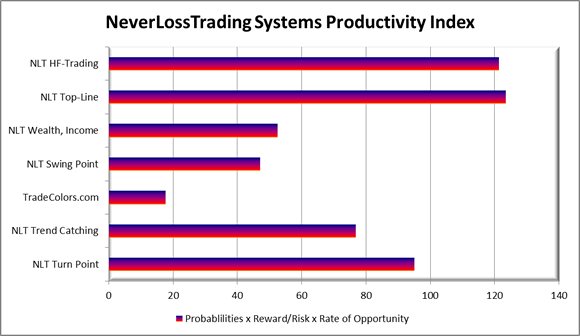
TradeColors.com is our introductory system to high probability trading. We always allow for upgrades; you only pay the difference if you start with TradeColors.com and upgrade after.

Many of our clients purchase more than one system: Our systems are productivity tools, and by combining them, you produce a higher participation rate and higher returns.

NLT System Index Productivity Comparison
NeverLossTrading Systems Compared

Our tool to calculate the expected price move is the SPU = Speed Unit, and it indicates how far a price move shall reach until it comes to an end. 

With our systems, you can operate with conditional buy-stop and sell-stop OCO orders (one-cancels-the-other). Without the need to be in front of your computer for the orders to execute. You enter by price thresholds, ensuring that other market participants have the same directional assumption as you do and exit at the SPU target or adjust the trade at the stop.

NeverLossTrading SPU Move Model

By a change in the frequency and amplitude of the price movement over time, we specify indications to act on high probability price turning points, applying mechanical rules rather than leaving room for interpretation.

With the help of the NeverLossTrading indicators, we report changes in supply and demand and multiple levels, time-based and based on pre-defined price moves and report the happenings:

  • On a monthly level
  • Weekly level
  • Daily
  • 4-Hour based,

We share the price thresholds: buy > or sell < through our alerts, or you can find them on your own with the help of system-related market scanners or watch list indicators.

We cover all asset classes: Stocks, Options, Futures, and FOREX.

As a retail trader, you have multiple opportunities for:

  • Day trading (opening and closing positions on the same day)
  • Swing trading (holding position for multiple days)
  • Longer-term investing (holding positions for weeks and months)

Based on clearly defined risk-limiting strategies, you can act with a high probability price move model on key price turning points.

With the help of our systems, we help retail traders to decide at trade entry for the  five significant challenges they face to prevent the common mistakes often made:  

  • Trade entry decisions (when to trade)
  • Exit decisions (where to take profit)
  • Stops (where to place them)
  • Maximum time in a trade (specified by the signal)
  • Risk to reward (only act at favorable setups)
Crucial Trading Decisions

Let us do short volatility or SPU measure comparison:

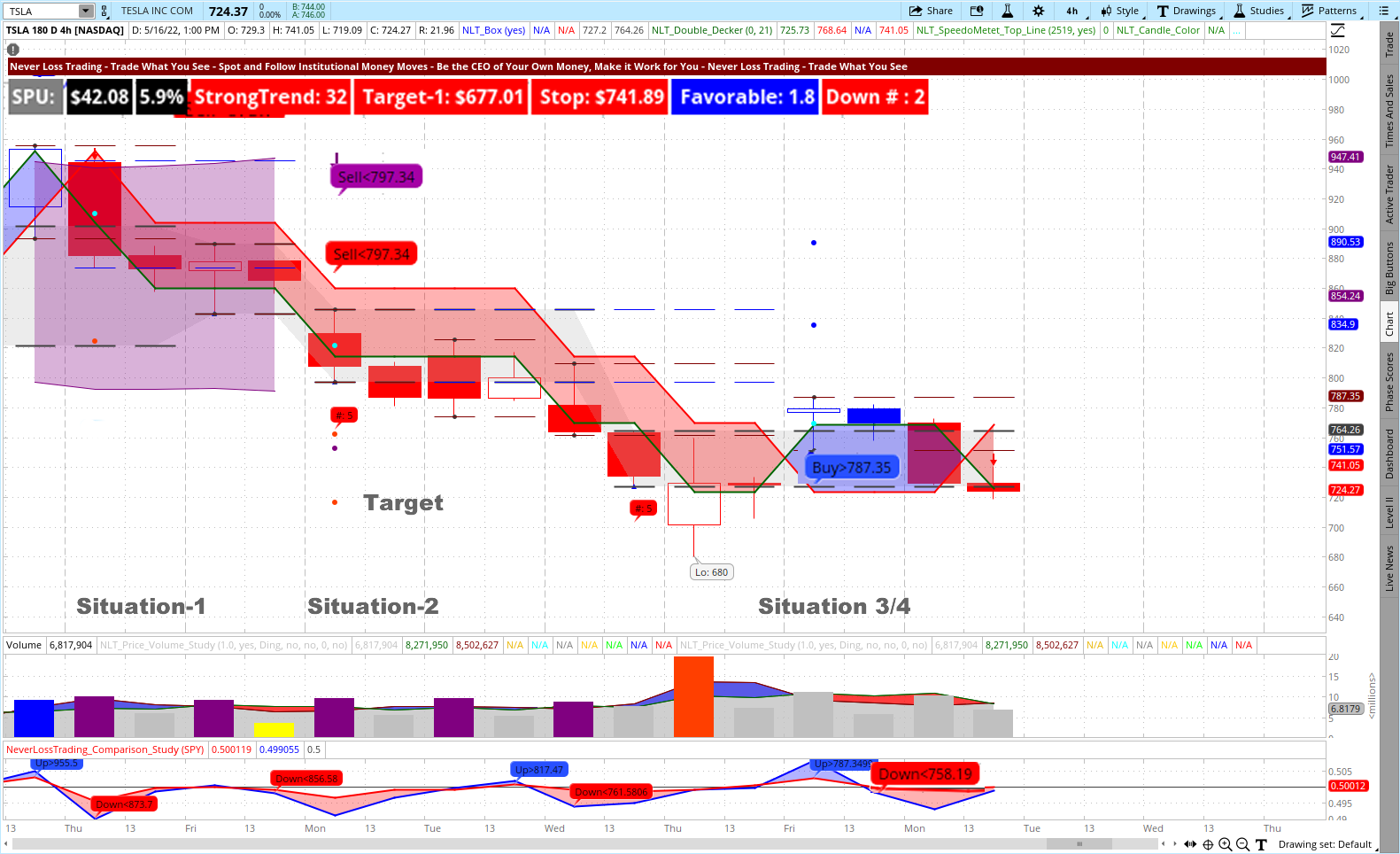
The actual daily SPU of Tesla (TSLA) on May 16, 2022, was $65.72, telling a trader that the share has an expected value change of 9.1% per day. On the other hand, the daily SPU for SPY (ETF of the S&P 500 Stock Market Index) was at $12.01 or 3.1%; hence, TSLA produces three times the opportunity for a trader to create income than the Index and entails three times the risk when your trade goes wrong. Twelve months ago, on the same day, SPY had an NLT-SPU of $5.34 or 1.3%, and TSLA showed an NLT-SPU of $32.90, or 5.9% and 4.5-times the volatility compared to the Index.

Our systems always tune you to the right SPU, specifying the trade exit and stop. However, suppose you trade for an inadequate price expansion or an ineffective stop. In that case, it is like trying to receive an FM signal on your radio on the wrong frequency, and the results will either be distorted or fail by not having a connection to the underlying price movement.

When you failed in the past by the trade turning on you before it came to target, you now have a hint of using the wrong expected price move by not operating with the SPU.

The following chart explains:

TSLA on the NLT 4-hour Top-Line Chart

TSLA on the 4h NLT Top-Line Chart

The recorded time frame is May 4 to May 16, 2022, and we highlighted four trade situations and took directional price indications from the price chart and lower comparison study.

Situation-1: May 4 – 6, 2022, showed the NLT Purple Zone. We color up-trends in blue and downtrends in red; when no directional trend is present, we mix red and blue, and a purple zone appears on the chart. In times of ambiguity, we do not engage in trades, and the NLT Purple Zone helps the trader identify those situations. When a purple zone ends, we expect a directional price movement, and it happened.

Situation-2: Two of the NLT indicators agree on shorting TSLA if the price of Tesla in the next candle drops below $797.34. The Tesla share with most brokers is rated HTB (hard to borrow). Hence, we chose to trade options contracts to participate in the down movement of TSLA and applied the NLT Delta Force Concept, which specifies the strike price to choose, the time to expiration to pick and the maximum price to pay for the option. This is where most traders struggle, and we help with a clearly defined concept to determine the action to take. On the chart, you see the trade target market by two dots, and when the price move to the dot concluded, we close the positions. To reach the lower dot, marked as target, we expected a maxium of 10 candles and got there after six.

Situation-3: A potential long signal: Buy > $787.35; however, the set price threshold was not achieved in the price movement of the next candle, and no transaction was initiated.

Situation-4: From the lower study, the Down < $  758.19 signal was confirmed in the price movement of the next candle and led to a short trading strategy on TSLA that came to target the next day.

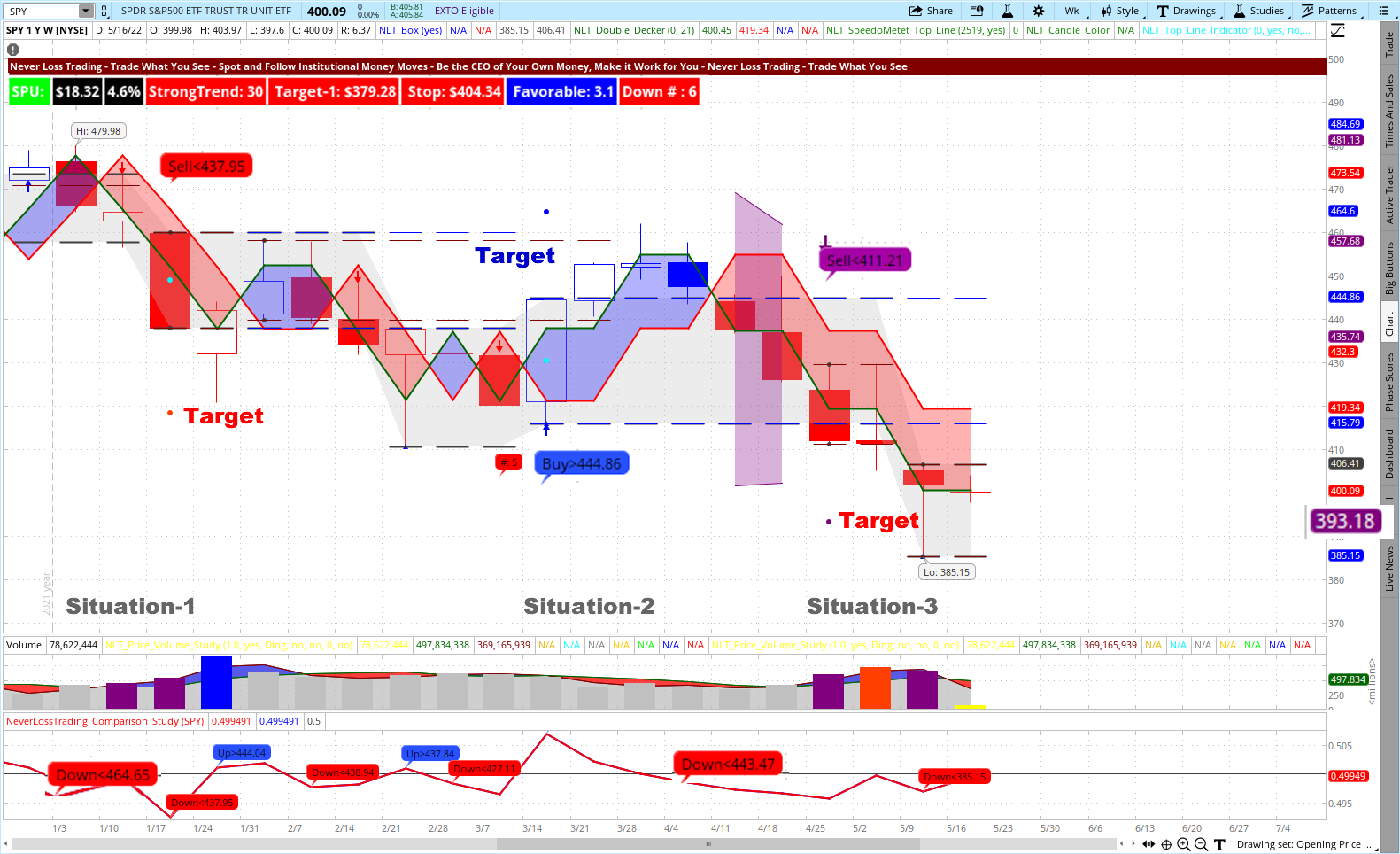
Let us take a longer-term perspective, which you should consider, in particular, if you hold a portfolio of stocks in your retirement accounts (401(k), IRA). In such cases, we chose a weekly chart for decision-making and select again the SPY (
ETF of the S&P 500 Stock Market Index) as the core measure of the stock market. You will see three highlighted trade situations and their decisions from left to right.

SPY on the Weekly NLT Top-Line Chart

SPY on the Weekly NLT Top-Line Chart

Situation-1: Right after the first week of January 2022, a lower study sell signal pointed towards a weak opening of the market. The signal was confirmed in the price movement of the next candle and then followed up by a price chart sell signal: Sell < $437.95, which took five bars to come to target, where the trade was closed.

Situation-2: Buy > $444.86 was confirmed in the price movement of the next candle. The dashed lines on the chart indicated that the price movement to the target has to be cut short, and the price level of $459.50 was the exit point.

Situation-3: The lower study indicated a confirmed short-selling signal: Down < $443.47, which was later supported by the end of purple zone signal, Sell < $411.21 and closed the trade at target ($393.18).

These two examples explain how vital a clear-cut volatility-based price move strategy is to follow the swings of the markets at crucial price turning points.

How did you judge the situations on your own, and do you have adequate strategies on hand to trade along with developing price moves?

We are entering a bear market, where buy and hold is not a sound survival strategy. If you want to make judgments from charts as we did here, contact us for a demo:

contact@NeverLossTrading.com Subj: Demo.

NeverLossTrading is a concept that customers adapt to traders’ affinity, wants, and needs. We focus on acting at crucial price turning points and take our price move indications from several sources or market cuts. We have signals that check for price correlations, others for volatility or volume change. Combining NLT Systems gives traders a higher participation rate: more trades to participate per day, week, or month, where each system works as a standalone.

No trader is the same as another. We offer excellent customer service and adopt our systems to individual wants and needs, teaching and coaching at your best available days and times. We put together an overview of learning elements to take away from our training and coaching sessions:

Summary of learning elements:

  • Acting with a system probability > 65%
  • Mechanical rules for entry, exit, stop
  • Trade at perfect moments only
  • Consider overall factors, patterns
  • Risk and reward in an acceptable balance
  • Risk-averse trading
  • Holding positions to target
  • Do not add to losers
  • Stick with a trading strategy. Follow a business plan – action plan and financial plan
  • Trade for meaningful price moves
  • Systematic trading
  • Having a mentor to learn from

Learning Elements to Trading Success

Learning Elements in NeverLossTrading Programs

We also help you to journal your trades. Such a journal provides excellent feedback on how you are developing, and you find a perfect example in this article on our Blog: How to Control Your Trading Results

To succeed in trading, you must work with an experienced coach and learn as much about trading. Our #1 competitive advantage is the support and customer service we offer. We work one-on-one with you to specify what we teach to your specific wants and needs; hence, if your knowledge base is not expanding rapidly, you are doing something wrong.

Ongoing education and mentoring are crucial to longevity in this business.

Veteran traders have been through more ups and downs than you can imagine. So whatever you’re going through, experienced pros have probably experienced it already.

If you are ready to learn, meet us in a one-on-one session where we find out which learning program suits you best:

contact@NeverLossTrading.com Subj: Demo.

We are ready to share our experiences and help you build up your trading business. Trading is not a typical career, and you best learn from those who are long-term in this business to cope with the rollercoaster of the financial markets. We are here to help and provide feedback on what you might be doing right or wrong.

Make a change to your trading results, and we will find out which of our systems suits you best.

We are happy to hear back from you,

Thomas Barmann (inventor and founder of NeverLossTrading)

www.NeverLossTrading.com

Disclaimer, Terms and ConditionsPrivacy | Customer Support