Discover a range of powerful market strategies in our exclusive special report — a comprehensive guide available as a free download for a limited time.
What you’ll find in this report isn’t predictions about where the market is going. It’s a look at how people who’ve been tested — in real environments, under real pressure — actually structure a trade.
There’s no cost to access it. But time is of the essence.
The team at Investing Target has just completed an ambitious project in record time. They’ve brought together eight of the industry’s most respected fund managers and educators to address how to trade in and out of earnings.
Discover the secrets of profitable trading and investing with Traders World Magazine Issue #96! This edition bridges the gap between historic trading philosophies and cutting-edge AI-driven systems. Don't miss our featured article, "Quantitative Trading Decisions," on page 30—packed with invaluable insights to elevate your trading strategy.
For a limited time, we're granting exclusive access to this treasure trove of market insights for free.
In more than 10 years of innovations, we developed a new concept for day trading options, and if this is of your interest, email us and we will send you an introduction document:
contact@NeverLossTrading.com Subj.: Day Trading Options
Good trading,
Thomas Barmann of NeverLossTrading
P.S. Opportunities like this don't come around often. Stay ahead of the curve.
Unveil the secrets of profitable trading and investing with the latest edition of Traders World Magazine—Issue #93! Our feature article, ” Trading: Buying Dare and Selling Dearest,” awaits you on page 28, ready to impart invaluable insights that could transform your trading game.
In the fast-paced world of financial markets, traders are often bombarded with information, opinions, and predictions about where prices are headed. In the midst of this information overload, a timeless trading principle emerges as a guiding light: “Trade what you see.” This powerful philosophy underscores the importance of chart analysis and allowing the price chart to dictate your trading decisions. Paired with the innovative strategies of NeverLossTrading, this approach becomes an even more potent tool for success.
The Power of the Price Chart: A Window into Market Reality
At the heart of “trade what you see” is the belief that the price chart reflects market reality. Every price movement encapsulates market participants’ collective actions and sentiments. By honing in on the raw data provided by the chart, traders can tap into the true pulse of the market, free from noise and biases.
Chart Patterns: The Language of Price Movement
Chart patterns are the visual manifestations of market behavior, and we use multiple indicators and studies to make the action visible for you as a day trader, swing trader or longer-term investor. These patterns hold critical information about potential price movements. Each pattern tells a story—about potential reversals, continuations, or trend shifts. By training the eye to recognize patterns, traders gain an edge in deciphering the market’s intentions.
NeverLossTrading’s Chart-Driven Approach: A Game Changer
Enter NeverLossTrading, an innovative trading system that embraces the essence of “trade what you see:” Armed with proprietary indicators and strategies, NeverLossTrading’s chart analysis approach enhances this philosophy’s power. Here’s how:
Objective Signals: NeverLossTrading generates objective buy and sell signals based on proprietary indicators. These signals provide clear, data-driven cues for entering or exiting trades, eliminating the ambiguity often associated with decision-making.
Emotion-Free Trading: By relying on chart-driven signals, traders are freed from the shackles of emotion. Fear and greed take a back seat as traders trust the objective insights from the charts.
Backed by Education: NeverLossTrading equips traders with education—a deep understanding of chart patterns, technical indicators, and strategies. This education empowers traders to not only see the charts but to interpret them with confidence.
Risk Management: In pursuing “trade what you see,” risk management is paramount. NeverLossTrading integrates risk management techniques to safeguard capital, ensuring every trade is approached with calculated prudence.
Adaptability to Trading Styles: Whether you’re a day trader, swing trader, or long-term investor, NeverLossTrading’s strategies can be tailored to your preferred style. The chart-driven approach transcends trading horizons.
Conclusion: Trading Clarity in an Information Storm
“Trade what you see” is a timeless trading mantra that resonates across generations. By allowing the price chart to guide your decisions, you tap into the essence of market behavior. NeverLossTrading takes this principle to new heights by infusing it with the power of proprietary indicators, objective signals, and comprehensive education. As you embark on your trading journey, remember that the charts are critical to unlocking trading success—clear, objective, and ever-reliable. It’s not about predicting; it’s about observing, interpreting, and acting with confidence. In the world of trading, where chaos can reign, the charts stand as your steadfast compass, pointing the way to profitability.
At this point, we best add some examples where we introduce the NLT decision-making principle:
Let the chart tell when to buy or sell!
For longer-term decisions, we use weekly charts. Swing trading decisions derive from daily charts, and for day trading, we mainly focus on what we call timeless charts: trading price-action oriented.
Swing Trading Example
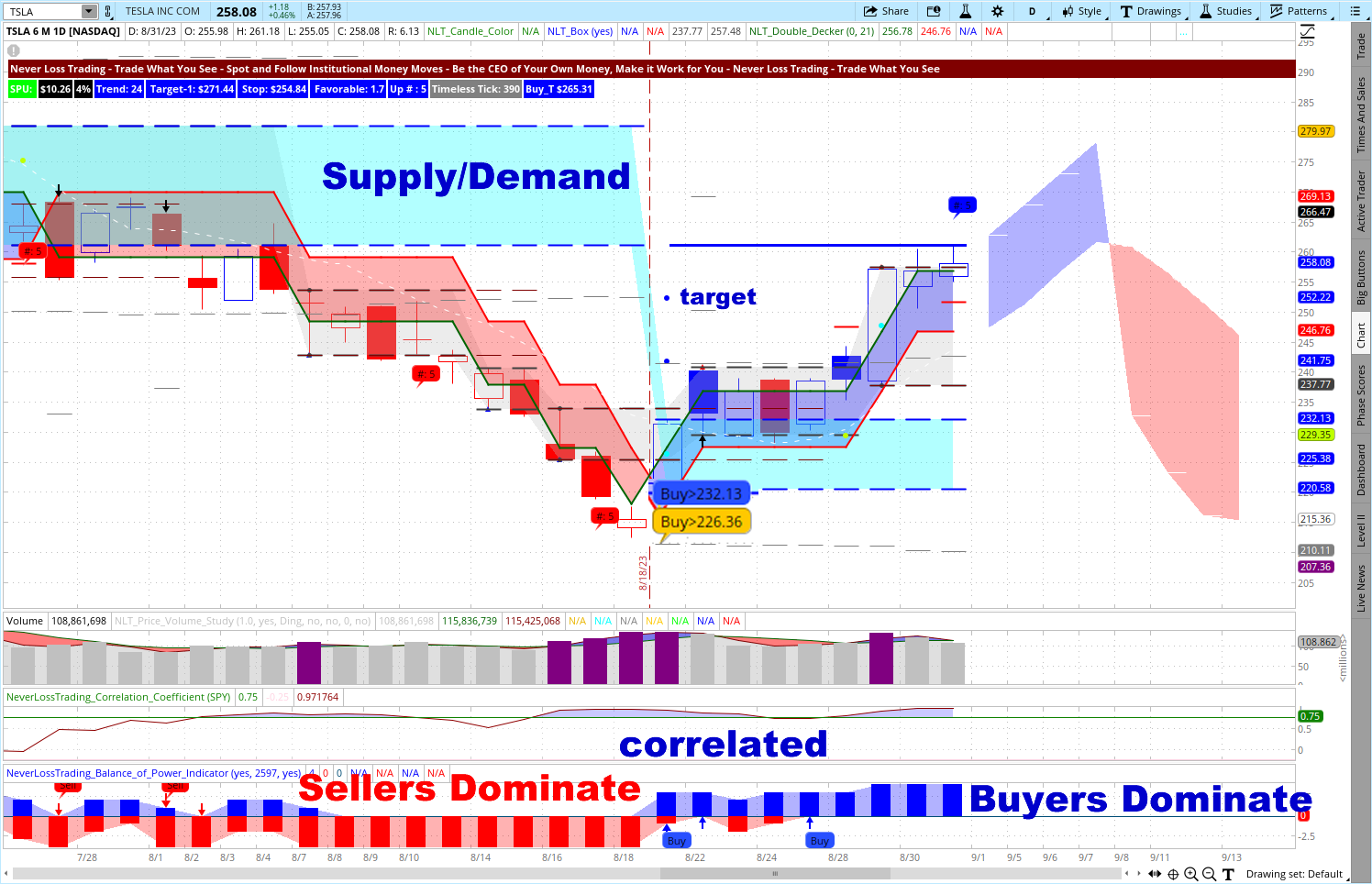
The daily NLT Top-Line chart specified the entry, exit and stop of the trade:
Buy signal on August 21, confirmed on August 22
Entry > $232.13 (buy strategy)
Exit (target) at $252.50
Expected time in the trade: maximum of ten trading days, and the trade closed after six trading days
Stop or price adjustment level at 220.50
Either stocks or stock options according to the NLT Delta Force concept were traded
On August 21/23, two of our NLT Top-Line indicators printed buy signals on the daily chart:
NLT PowerTower (Blue)
NLT Bottom Reversal (Orange)
The direction of the buy signals was confirmed by the price movement of the next day (August 22, 2023) and offered going long in the stock. The chart further shows price zones highlighted in cyan, which indicate where we expect intense exchange and exit positions when we get to such zone border. A bottom study shows who is in charge (buyers now, prior sellers) and indicates that TSLA is moving with the overall market.
We hope this demonstrates how to let the chart tell when to buy or sell. Take the chance and experience in a life session what our systems can do:
Let us now take the same approach and what you learned to discuss how longer-term opportunities unfolded on a weekly chart:
TSLA, Weekly NLT Top-Line Chart
The chart shows three candles, highlighted by NLT Signals: Two directional signals were confirmed and came to the system-set target (dot on the chart).
Buy > $252.42 led to a trade in the week of June 12/23
Buy > 240.82 led to a trade in the week of August 28/23
Both trades reached their targets.
The bottom study highlights when buyers or sellers were in charge of the price movement.
Day Trading Example
Our preferred way of day trading is purely price action-oriented: candles are not drawn time-based, but price-based, which specifies the concept’s name: NLT Timeless Trading. The chart shows multiple trading opportunities in the August 28, 2023, day session: two long and one short. In the example, we acted on the short signal, and the trade auto-closed after about six minutes.
E-Mini S&P 500 Futures Contract, August 28, 2023
The same day, we acted on another opportunity. The chart shows multiple signals, and we will teach how to determine which signals to act in our training and coaching sessions. Again, you see the time stem of the trade, and we always base our examples on trading one contract to give you a relation to the income basis: August 28, 2023, was $512.50.
E-Mini S&P 500 Futures Contract, August 28, 2023
Dots on the chart identify the exit, and red crossbars the stop.
There is undoubtedly much more to explain and show, so take the opportunity to experience in a life session how to act by letting the chart tell when to buy or sell:
We help our students simplify technical analysis by providing a holistic approach that combines chart patterns, trend analysis, and market indicators. Traders are equipped with practical tools and methodologies to identify high-probability trade setups, helping them make informed decisions based on market trends and price action.
Executing trades at the right time and price can be challenging, especially in fast-moving markets. NeverLossTrading offers techniques for precise trade entries and exits, allowing traders to capture optimal returns. With its focus on high-probability setups and systematic approach, NeverLossTrading helps traders improve their trade execution and timing, maximizing their profit potential.
The financial markets are dynamic and ever-evolving, requiring traders to stay updated and continuously learn. NeverLossTrading promotes a culture of continuous learning, providing educational resources, webinars, and personalized mentoring. Traders gain access to a wealth of knowledge and expertise, empowering them to adapt to changing market conditions and enhance their trading skills.
Trading challenges are an inherent part of the financial markets, but with the solutions offered by NeverLossTrading, traders can overcome these hurdles and thrive in their trading endeavors. By addressing emotional biases, providing effective risk management techniques, simplifying technical analysis, optimizing trade execution, and fostering continuous learning, NeverLossTrading equips traders with the tools and knowledge needed for success. Embrace the solutions provided by NeverLossTrading and embark on a journey toward consistent profitability and trading excellence.
To succeed in trading, you best work with an experienced coach. Our #1 competitive advantage is the support and customer service we offer. Veteran traders have been through more ups and downs than you can imagine. So, experienced pros have probably experienced whatever you’re going through. If you are ready to make a difference in your trading. We are happy to share our experiences and help you build your trading business. Trading is not a typical career, and you best learn from those who are long-term in this business to cope with the rollercoaster of the financial markets. We are here to help and provide feedback on what you might be doing right or wrong. Strive for improved trading results, and we will determine which of our systems suits you best. The markets changed, and if you do not change your trading strategies with them, it can be a very costly undertaking. Hence, take trading seriously, build the skills, and acquire the tools needed. Trading success has a structure you can learn and follow.
Thomas Barmann (inventor and founder of NeverLossTrading)
How to tailor your trading program to your wants and needs? Success has a structure, and if you are not applying a structured approach, your chances for a positive outcome will be random.
Depending on which trading style fits your life, different concepts or structures support your goals.
Therefore, we distinguish three trading styles and recommend choosing a style that fits your lifestyle, and indeed, you can combine trading styles:
Day Trading: Opening and closing positions the same day
Swing Trading: Keeping open positions for a couple of days
Longer-Term Investing: Holding open positions for weeks, months
Our teaching and coaching are individual and focused on your preference, return expectations and available time. Over the years in business, we did not find two trades with precisely the same style or program adaptation; people are different in:
Overall time commitment
Time to trade and decide
Risk tolerance
Return expectations
The primary income, side income, retirement income
Account size
Affinity to assets (stocks, options, futures, FOREX)
Level of skill and knowledge
Average time to keep open positions
Account type: margin, IRA, 401(k)
Commitment to documentation and continued improvement
Hence, our system and strategies adjust to you like a tailor-made suit because we know one size does not fit all!
In any case, we can still share some base principles to consider through all trading styles and put those in a table for you.
The Structure of Trading Success
Trading Style
Day Trading
Swing Trading
Longer-Term
System
Mechanical
Mechanical
Mechanical
Return Expectation
Example: $1,000 per week trading one futures contract
2% – 5% return on capital engaged per week
2% to 5% return on capital engaged per month
Activity (number of transactions)
2-3 trades per day
2-5 trades per week
2-5 trades per month
Risk Limiting Strategies
Given
Combining assets with options
Combining assets with options
Trade Repair
None
Important
Important
Asset Preference
Futures, FOREX, Stocks
Stocks & Options Futures, FOREX
Stocks & Options Futures, FOREX
Average time in a position
Minutes or hours One to five bars
One to five days
One to five weeks or one to five months
Skill Level
Highest: solid short-term decisions
High
High
Documentation
Every trade and 20-trade review
Every trade and 20-trade review
Every trade and 20-trade review
Let us elaborate on this:
System
You want a high-probability trading system that forecasts the price movement with clearly defined entry, exit, and stop conditions regardless of the time of holding positions. Give yourself little to no room for discretionary decisions: Trust your system and accept that you work with uncertainty at or above a rate of 65%, and we can help you achieve this.
Return Expectations
The higher your return expectations are, the better your skill and dedication need to be. If trading and investing were easy, nobody would ever go to work. Return, risk and investment size go hand in hand, and we share strategies to specify a fixed income per time period, achievable with a small number of trades.
Why a small number of trades?
Retail traders tend to overdo their trading activity and accept too much risk. Trading is all about risk control and folding when you achieve your goal. For example, when working with day traders who trade Futures, we specify two contracts to trade and complete the weekly income budget of $1,000. Depending on the broker you work with, you need about $2,000 to $12,000 of capital to conduct these trades. When you reach the budget consistently, upscaling (trading more than one contract) is the conclusive next step, and you follow the same principle.
Here are two chart examples that combine NLT Top-Line, Trend Catching, and Timeless.
The first chart shows five potential trade situations; each spells out a price threshold like Buy > $4068 and provides a basis to trade for a price change of about $300 of the underlying contract. To execute a transaction, we operate with a buy-stop bracket order, and the trade only goes to the exchange when in the price development of the next candle, the set threshold is reached and the order executed. Five trade situations were highlighted, and all met their desired target (gray dot on the chart). Non got stopped (red crossbar on the chart).
E-Mini S&P 500 Index Futures Example
Next, we pick a crude oil futures example for the same day.
Crude Oil Futures Example
The Crude Oil Futures Chart shows nine trade situations with the same conditions and price thresholds. Accepting trades mechanically, without the evaluation to learn: six trade setups came to target (1, 2, 3, 5, 6, 7, 8, 9), and two got stopped (4, 5).
We hope you see in the red crossbars where to put the stop. Targets are expressed in dots, and we only enter into a trade when the price threshold is ticked out in the price movement of the next candle.
We could add multiple charts, and if you want to see more:
Next, let us discuss swing trading and longer-term investing with the same principles:
Imagine you are a swing trader, and you hold $50,000; a two percent return on cash would be, again, an income of $1,000 weekly. Now let us quickly calculate how many trades you need, winning two out of three to get to the budget, assuming that your accepted risk is 1.2 times your reward. So the answer is again about four trades. Hence, you do not need to transact that often to achieve your goals. The example for a longer-term investor with a 2% monthly return would calculate equally and ask for about four trades to complete the budget. We combine this concept in what we call less is more: – = +, but we wanted to give you a meaningful introduction to a different way of thinking and acting to achieve your trading goals long-term. Striving for constant income from the financial markets, you need more than a buy-and-hold strategy. You need the knowledge of how to combine, for example, stocks with options or trade options to limit your risk because opposite gaps quickly can get you way outside of your assumed risk and cut deep into your profits. When you get into action, you will notice that some trades go opposite, and then our method of trade repair comes into play, which gave us our brand name: Never Stop Loss Trading was a bit lengthy.
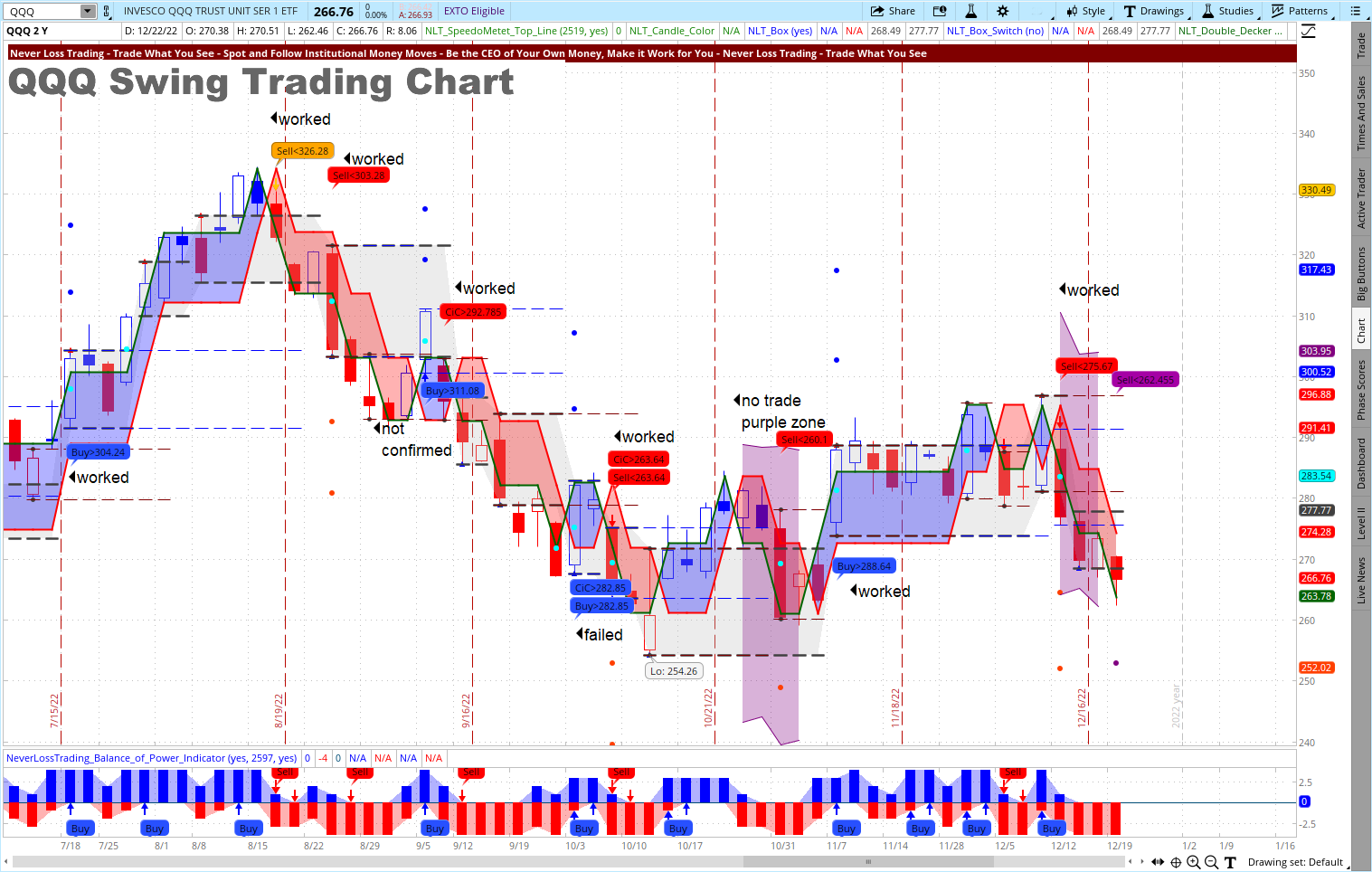
Swing Trading Example QQQ
The QQQ chart shows a swing trading example, and you see multiple directional indications with buy and sell thresholds: Buy > or Sell <, and we only act if the set number is reached in the price movement of the next candle. The holding time is a couple of days. Dots specify trade targets, and red crossbars are the stop levels.
The daily NLT Speed Unit (SPU) for the QQQ swing trade is around 2.5% and as such, this is the return you strive for per trade. When using the NLT Delta Force Concept, surely multiple times higher, but you also have a higher associated percentage risk. In the continuation of this article you will learn how the return you strive for will support meaningful weekly swing trading goals and the QQQs are perfectly in spec. for stock and options trades.
If you want to hold open positions for multiple weeks, the SPX provides a solid basis for longer-term positions. Again, you will find buy and sell indications with thresholds; horizontal lines build express supply lines on pullbacks, where we propose to exit in the current overall bear market.
Longer-Term Trading Example SPX
The SPX chart shows six trade situations where five worked according to plan and one failed.
Depending on the account type you are holding, a change in strategy is required to participate in downside moves:
IRAs do not allow for short-selling stock, and we help you with the NLT Delta Force Concept to participate in falling prices by options trading strategies, allowed in this account type
If you are operating from a margin account, you have fewer limitations, but you must hold more than $25,000 to short stocks. Again, we provide options trading strategies that limit your risk and leverage your reward per trade.
You now see how goal setting influences your way to market and requires you to change because needs constantly change, and you do not want to be left behind. So at this point, our support kicks in, and we provide the required tools and knowledge.
Also, in day trading, we recommend formulating a goal and measuring success in getting there. Hence, we recommend that our traders work towards short-term budgets. For example, as a day trader, to produce an income of $1,000 by trading one contract of either the E-Mini S&P 500 Futures Contract or Crude Oil Futures – two highly liquid assets with no limitations for following the up or downside direction. Then, when the weekly budget is hit, you stop trading. In addition, we encourage you to limit the maximum number of daily trades to three – following our concept that less trading is more: – = +. Finally, you restart the clock every week and journal your achievements to discuss what went right or wrong to improve your actions after every set of twenty trades. Depending on your broker’s margin requirement, you can participate in this exercise with a capital between $500 and $12,000.
Day trading success has a structure or pattern to follow, and I want to show you some tools that can help you form sound decisions at high probable price turning points. We pick two examples to demonstrate what our systems can do and discuss the individual trade setups. Again, the systems will formulate buy or sell thresholds (buy < or sell >). Target (dot on the chart) and stop (red crossbar) are system set, allowing you to operate with buy-stop and sell-stop bracket orders. For days trading, we choose a timeless chart setup, where candles form purely price based, and the system sets the price increment to trade. With modern AI technology and highly probable algorithmic trading systems, your market outlook and action will change, helping you to form sound mechanical decisions and act repetitively. With what we show you, three to four weekly winning trades make the $1,000 budget. We then encourage you to stop trading: overtrading is one of the strongest pitfalls of a day trader: reach the budget and be good, and trust our advice: less trading is more: – = +.
We share two examples showing NLT Timeless Day Trading Charts for the E-Mini S&P 500 and the Crude Oil Futures contract. On an NLT Timeless chart, candles are formed purely price-based, and the system defines the price increment to trade for. In our examples, we evaluate each signal as it appears valid while following the concept of less is more; you will learn during our trading sessions selection criteria to distinguish higher from lower probability setups.
Risk Limiting Stragegies
As a day trader, risk limiting is simple: you work with bracket orders (OCO, once cancels the other); however, your system, not you, needs to decide on entry, exit, and stop.
When we come to swing trading or longer-term investing, you are exposed to overnight gaps that increase your risk acceptance. To get around an extended risk, combining, for example, stocks with options or trading options limits your risk exposure. We teach the NLT Delta Force Concept, which specifies at any point:
The strike price to pick
The time to expiration to choose
The maximum price to pay or apply a different strategy
Skill and knowledge make a significant difference to your expected returns. We are here to support you in gaining the knowledge needed to strive for solid returns regardless of market direction.
Trade Repair
As a day trader, when a trade goes wrong, it goes wrong, period. We tested methods of opening up opposite-oriented trades but found no value in this concept. The reason is: we want to trade on solid system indications, and a transaction coming to a stop does not mean it allows for opening an opposite trade and successfully bringing it to target. In rare cases, was the stop-candle a candle with a strong opposite signal indication, and we are trading at high probability setups only. However, trade repair enormously impacts swing trading and longer-term investing. Imagine a set of six trades, each winning $1,000 or losing $1,200; when winning two out of three transactions, your expected income from a group of six trades is $1,600. If you reduce your losing trades through a trade repair to half ($600), the expected outcome is $2,800 or a 75% improvement, and often you can even do better or turn losers into winners. However, the average retail trader does not possess the skills we bring to the party and share in our mentorships.
Skill
Trading is not just about an indicator; it takes multiple dimensions to turn yourself into the trader or investor you want to be. Therefore, we support you in acquiring the necessary knowledge and skills.
Success Factors for Trading and Investing
To succeed in trading, you best work with an experienced coach and learn much about trading. Our #1 competitive advantage is the support and customer service we offer. We work one-on-one with you to specify what we teach to your specific wants and needs; hence, if your knowledge base is not expanding rapidly, you are doing something wrong.
Ongoing education and mentoring are crucial to longevity in this business. Veteran traders have been through more ups and downs than you can imagine. So, experienced pros have probably experienced whatever you’re going through.
If you are ready to make a difference in your trading:
We are happy to share our experiences and help you build your trading business. Trading is not a typical career, and you best learn from those who are long-term in this business to cope with the rollercoaster of the financial markets. We are here to help and provide feedback on what you might be doing right or wrong.
Strive for improved trading results, and we will find out which of our systems suits you best.
The markets changed, and if you do not change your trading strategies with them, it can be a very costly undertaking.
We are looking forward to hearing back from you,
Thomas Barmann (inventor and founder of NeverLossTrading)
Successful traders and investors follow clear guidelines, watch for positional advantages and act on indications for critical price changes.
Why do we bring together trading and a chess strategy?
Beginning chess players act reactive, while experienced players work to reach certain positional advantages from the opening through the middle game into the end game. They are looking for structure and follow success principles.
Successful traders act similarly; they operate with concepts and strategies and wait for the specific moment to gain a positional advantage and then risk their money to yield a return. If you are unfamiliar with chess, think about high-level football, baseball, basketball, or soccer, where pros train to reach pre-defined positions and act.
Concluding the intro question:
Do you have a trading strategy you follow?
What is the basis of your decision-making?
Do you yield returns?
In modern times, when you play online chess, you can decide on the time given to you and your opponent, from three minutes to hour-long games. Similar to trading, you can choose the time of your decision-making:
Day traders open and close trades the same day and decide on short time frames
Swing traders keep open positions for a couple of days and mostly decide at the end of the day or intraday for their transactions
Longer-term investors hold assets for weeks and months and often decide about once a week or month for a change in their holdings
Regardless of how long you want to hold an open position, it would help if you created a positional advantage: an edge that lest you win with a high probability. Trading decisions are chosen under uncertainty and will never be 100% correct. We define high probability when you win 65% or above of your trades. Let us share two simple charts, one for a bit longer-term investment and one for swing trading.
S&P 500 Index Weekly Decisions 2022
We highlighted six situations on the NLT Top-Line chart and want to discuss them with you. First, you see a weekly chart where our indicators spell out price thresholds (Buy > or Sell <) to act when the price of the next candle passes the threshold. The drawn-out horizontal lines indicate system-defined supply levels on reversals.
Situation-1: two strong sell signals called for a bear market in 2022 and came to their expected price move to the downside.
Situation-2: a first reversal to the level of the horizontal NLT Box Lines and another down move
Situation-3: a reversal indication and followed through
Situation-4: a bottom reversal above the expected supply point
Situation-5: strong down move indicated by two NLT signals
Situation-6: the next down move was shown and happened
In essence, six trade situations and our indicators announced the price turning point to target five of the six.
QQQ Swing Trading Chart 2022
Now you see the positional advantage our strategies can bring. On the QQQ chart, we highlighted multiple price-turning points with a solid winning percentage. There are rules to learn, and we teach those in one-on-one sessions. What would it mean to your trading decisions to go long or short in such instances, with a high probability?
If you want to be part of algorithmic-based decision-making, contact us for our yearend special, and we will get together to find out how we can best support you as a day trader, swing trader, or longer-term investor.
We wanted to keep the introduction brief; if you want to learn more about our systems, watch this short video where we explain further details. Then, if you prefer to read the details, we send you a copy: contact@NeverLossTrading.com Subj.: PDF 2023.
The financial markets are dynamic and offer an excellent place for retail traders to operate. However, if trading were easy, nobody would ever go to work; however, it is learnable.
How do our indications make a difference?
We measure the market’s pulse by analyzing underlying supply and demand changes. Price moves have a pre-lude and in a multitude of dimensions, and there, our algorithms pick the indication, spell out entry and exit conditions and always stay real-time in tune with the price movement of the observed asset.
With more than ten years in the trading education business, we helped many make fruitful financial decisions. We work one-on-one only.
To succeed in trading, you best work with an experienced coach and learn much about trading. Our #1 competitive advantage is the support and customer service we offer. We work one-on-one with you to specify what we teach to your specific wants and needs; hence, if your knowledge base is not expanding rapidly, you are doing something wrong.
Ongoing education and mentoring are crucial to longevity in this business. Veteran traders have been through more ups and downs than you can imagine. So, experienced pros have probably experienced whatever you’re going through.
If you are ready to make a difference in your trading:
It takes multiple dimensions to turn yourself into the trader or investor you want to be, and we support you in acquiring the knowledge and skills needed.
We are happy to share our experiences and help you build your trading business. Trading is not a typical career, and you best learn from those who are long-term in this business to cope with the rollercoaster of the financial markets. We are here to help and provide feedback on what you might be doing right or wrong.
Strive for improved trading results, and we will find out which of our systems suits you best.
The markets changed, and if you do not change your trading strategies with them, it can be a very costly undertaking.
We are looking forward to hearing back from you,
Thomas Barmann (inventor and founder of NeverLossTrading)


 Download your free Copy